
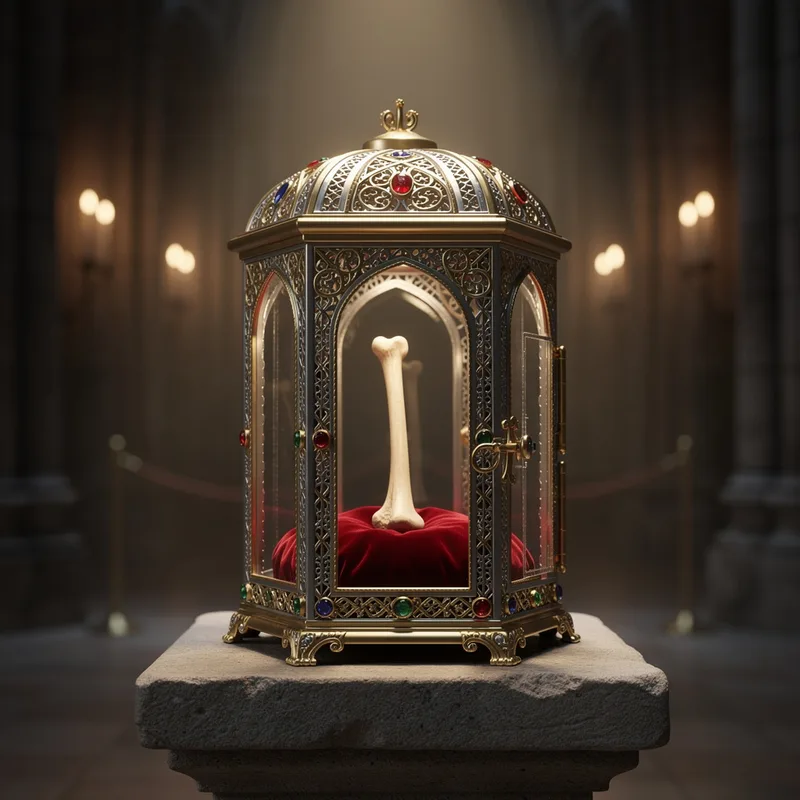
reliquary
 5
9.9
5
9.9

- noun
- /ˈrɛlɪkwɛri/
- Rasputin flings open the cabinet and we see the reliquary, glowing gently as if it were sleeping.
- reliquary housing the relics
- reliquary altar
- reliquary shrine
Examples
-
Here, Delalande adds Bertola's altar reliquary to the ensemble perceived from the cathedral.
Academic text (1995) -
Thus, the finished reliquary shrine stands well within the flanking columns of the proscenium.
Academic text (1995) -
Rasputin takes the reliquary out of the cabinet and sets it on the table.
Fiction book (1997) -
The high altar and its reliquary superstructure appear to project forward of the screen.
Academic text (1995) -
But Rasputin's not interested; he stares into the reliquary and speaks directly to it.
Fiction book (1997) -
Rasputin leans closer to the reliquary, which now contains the brightest colors we've seen.
Fiction book (1997) -
Indeed, it is possible that, as Heinrich Klotz suggested, the reliquary reflects the architect's lost lantern design of 1418.
Academic text (2004) -
Between 1422 and 1425, a new reliquary was made for Saint Philip's arm (Fig. 3).
Academic text (2004) -
Thirteen donors, led by the eighth-century Mercian king Aethelbald, present their gifts to Guthlac's reliquary shrine.
Academic text (1999) -
The reliquary displayed the sacred relics of the saint, attracting many worshippers.
Synonyms

An old container that holds holy objects or a saint's remains
Compounds
How Sacred

Surface Forms
Morphology
Etymology
Reliquary comes from the Latin word reliquiae, meaning 'remains', and it is related to the common English word relic, which means an object from the past. So a reliquary is a container for those 'remains' or sacred objects, which is why it holds a saint's bone or other holy relics.