
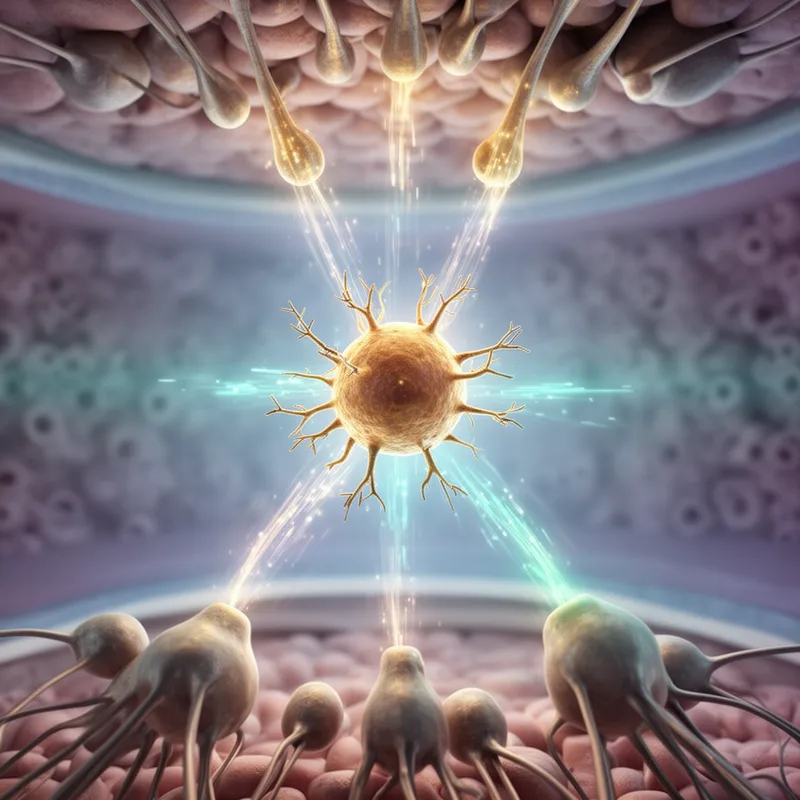
amacrine


 1
9.9
- noun
- /əˈmɑːkrɪn/
- Specialized
- Researchers found that amacrine cells can influence the way we perceive contrast in our visual field.
Examples
-
The amacrine cells in the retina play a crucial role in processing visual information by modulating signals between the bipolar and ganglion cells.
-
And then when we come down to the amacrine cells, OK, some of these amacrine cells produce action potentials, some don't.
-
Understanding the function of amacrine cells helps scientists learn more about how the retina processes images.
Synonyms
 2
7.1
A nerve cell in the brain or spinal cord that passes signals between other nerve cells
Surface Forms
Morphology
amacrine = a + macr + ine
As a technical biomedical term formed from classical combining forms, its internal parts are not transparent to typical learners and the noun sense is specialised rather than predictable from the components.
Etymology
Amacrine gets its name from Greek parts a- meaning 'not' and macr- meaning 'long', like in macro. An amacrine cell is 'not long', and that name fits because this retinal nerve cell lacks a long axon.