
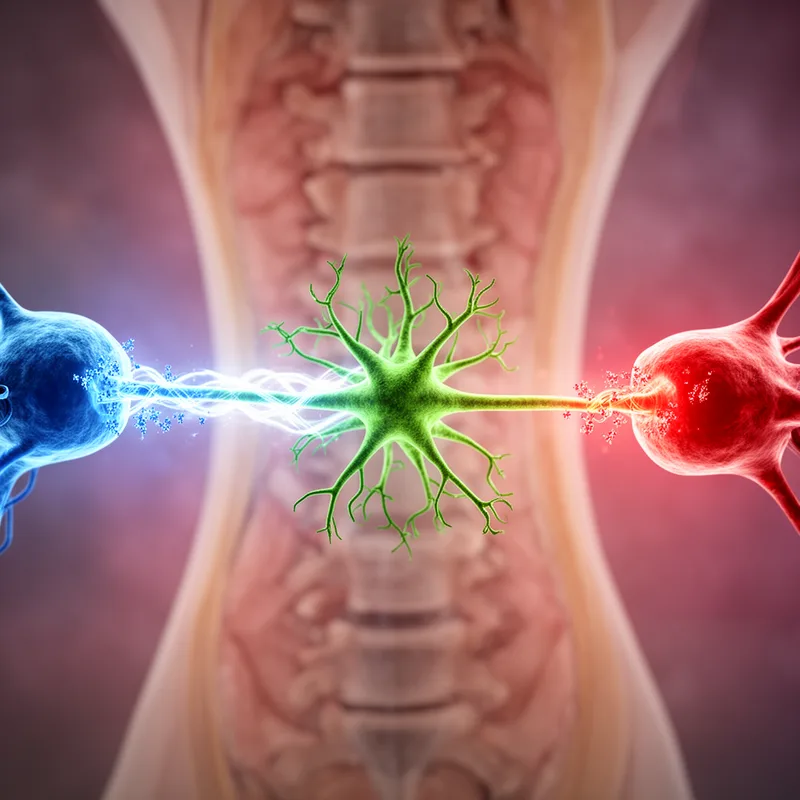
interneuron
 2
7.1

- noun
- /ˌɪntərˈnjʊrɒn/
- Specialized
- For decades, scientists have not known how the appropriate number of these interneurons is determined, how many are formed, when they die, and how many survive after reaching the cerebral cortex.
- inhibitory interneuron
- types of interneurons
- interneuron cell
Examples
-
The interneuron connects sensory neurons and motor neurons to allow for coordinated movement.
-
Clearly there are still more than a few misconceptions about the structural differences between sensory neurons, interneurons, and motor neurons.
-
So we think that those many small neurons, many interneurons, many mostly Gabaergic interneurons.
-
The neurons messaging the stem cells are parvalbumin-expressing interneurons.
Blog text (6) -
Further analysis revealed that a subcircuit of three C. elegans sensory neurons and one interneuron was necessary for this response (Shao et al. 2016).
Academic text (2017) -
Small-diameter afferent fibers connect to interneurons and synaptic mechanisms, which in turn produce long-lasting hyperexcitability.
Academic text (1999) -
Based on this theory, the UCSF team had expected that only a fixed and small number of transplanted embryonic interneurons would survive in the brains of older recipient mice, regardless of how many they transplanted.
Blog text (1) -
Researchers found that interneurons help regulate the flow of information in neural circuits.
-
Damage to interneurons can disrupt communication within the nervous system, leading to various movement disorders.
Synonyms
 82
4.3
A nerve cell that sends messages in the body
 61
2.8
A cell in the brain that sends and receives messages
 15
3.4
A cell that sends electrical signals to carry messages between the brain and body
Surface Forms
Morphology
Etymology
Interneuron comes from inter- meaning 'between' and neuron meaning 'nerve' or 'nerve cell'. So an interneuron is a nerve cell that sits 'between' other neurons and passes signals from one to another.