
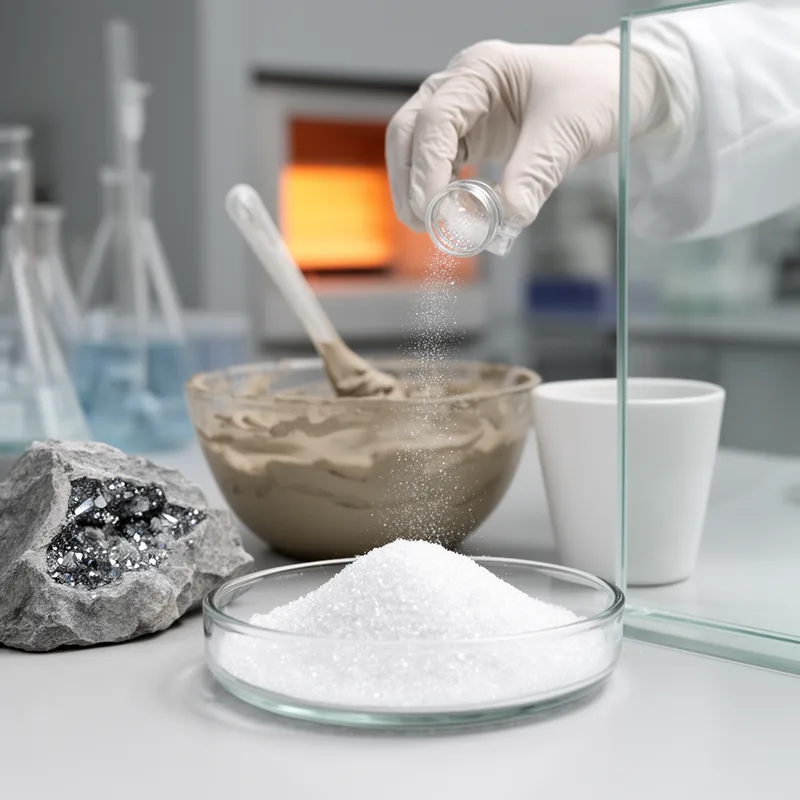
aluminosilicate


 1
8.5
- noun
- /əˌluːmɪnoʊˈsɪlɪkeɪt/
- Specialized
- The glassmaker preferred aluminosilicate for its durability and resistance to thermal shock.
- aluminosilicate gel
Examples
-
For chemically strengthened glass (soda lime and aluminosilicate), the advantages are derived mainly from their stiffness and hardness 11, 12.
Academic text (1996) -
This means that almost all calcium aluminate cement took part in geopolymerization reactions, forming the geopolymer aluminosilicate (N-A-S-H) network.
Academic text (2018) -
The most readily available used materials for the synthesis of GCs are fly ash, metakaolin, and natural aluminosilicate minerals.
Academic text (2018) -
Its major phase has a 94.7% fraction and aluminosilicate gel with a SiO2/Al2O3 ratio of 4.1, while the other phase consists of aluminosilicate gel with a SiO2/Al2O3 ratio of 7.4.
Academic text (2017) -
A new geopolymer phase is identified following the geopolymerization of Pt. Augusta, and it contains calcium-aluminosilicate gel with a SiO2/Al2O3 ratio of 1.4, as a 6.7% fraction.
Academic text (2017) -
The aluminosilicate minerals are essential components in the production of high-strength ceramics.
-
Researchers studied the properties of aluminosilicate compounds for use in advanced materials.
Surface Forms
Morphology
Etymology
Aluminosilicate is built from two parts: alumino-, from aluminum which is a light 'metal', and silicate, from silicon which is an element common in 'sand' together with oxygen. So, an aluminosilicate is a material made of aluminum, silicon and oxygen, which is why it appears in minerals and is used in strong ceramics and glass.