
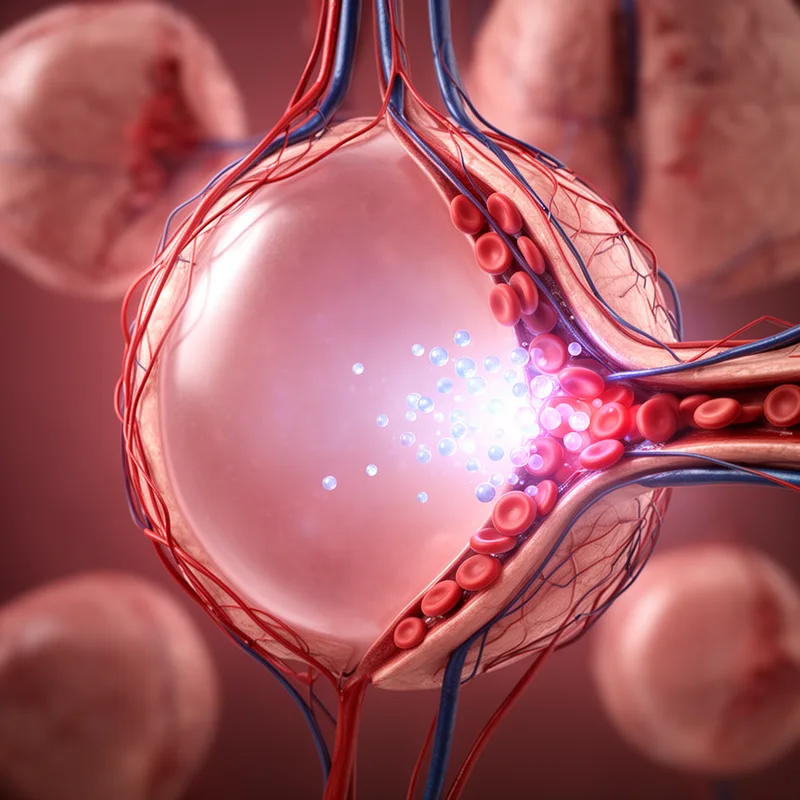
air cell
- noun
- /ɛr sɛl/
- Specialized
- Erosion of the petrous bone and coalescence of mastoid air cells were present.
- mastoid air cells
- persistent air-cell
- air-cell disease
Examples
-
A soft-tissue density may be visible in the middle ear cavity with opacification of mastoid air cells.
Academic text (2005) -
The hallmark finding is osseous destruction of the mastoid air cells.
Academic text (2008) -
Are mastoid air cells involved as well?
Academic text (2002) -
Complete eradication of all diseased mastoid air cells is, of course, also essential.
Academic text (2001) -
Of these 67, he found ethmoid air cells in 38 (57%).
Academic text (2008) -
B: Axial CT scan shows the bony mass (arrow) and mastoid air cells (left side).
Academic text (2008) -
Superficial lesions of the mastoid and squama were drilled until normal mastoid air cells were reached.
Academic text (2008) -
We tabulated data on the location of persistent air-cell disease, the presence or absence of cholesteatoma, and the significant mechanical factors that contributed to recurrent symptoms.
Academic text (2002) -
Intraoperative findings of interest during revision surgery were the presence or absence of cholesteatoma, the site of persistent air-cell disease, and the presence or absence of a small meatus or a high facial ridge.
Academic text (2002) -
The doctor explained that the air cell in the lungs is essential for breathing.
Synonyms


 1
8.2
1
8.2
A tiny air sac in the lungs where oxygen enters the blood and carbon dioxide leaves the blood
A thin sac in birds and some other animals that holds air and helps them breathe
Surface Forms
Morphology
The meaning 'a tiny sac in the lungs holding air' is directly and compositionally derived from 'air' (gas) + 'cell' (a small unit or compartment), i.e. a cell containing air. This straightforward noun+noun compounding follows common English and cross-linguistic patterns, so a B1 learner who knows both constituents would likely infer the meaning.
Etymology
The noun air cell comes from a simple picture: tiny cells or rooms in the lung filled with air, like small bubbles. These little pockets let oxygen pass into the blood, so the name explains why it means 'a tiny sac that holds air'.