

afferent nerve
- noun
- /ˈæfərənt nɜrv/
- Specialized
- The afferent nerve carries signals from the skin to the spinal cord, allowing us to feel sensations.
- afferent nerve fibers
Examples
-
At the base of the hair cell, there are vesicles and synaptic specializations with afferent nerve fibers contributing to the auditory nerve and sending information to the central nervous system.
Academic text (1998) -
Outer hair cells synapsing on afferent nerve fibers contribute to the auditory nerve and innervate the cochlear nuclei.
Academic text (1998) -
Type I hair cells are flask-shaped and connected to a single large afferent nerve fiber.
Academic text (2005) -
This impulse is propagated by the afferent nerves toward the vestibular nuclei.
Academic text (2005) -
Among them is bradykinin, a very potent activator of group III and IV afferent nerve endings, the afferents that signal pain to the CNS.
Academic text (1997) -
In the reflex arc, an afferent nerve transmits information about pain to the central nervous system.
-
Afferent nerves play a crucial role in relaying sensory information from the body to the brain.
Synonyms



 1
3.7
1
3.7
A long thin part that sends feelings from the skin to the brain and spinal cord

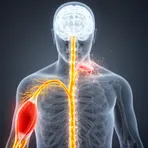
A nerve that carries information from the body to the spinal cord or brain
Antonyms
- Specialized
A nerve that sends signals from the brain and spinal cord to muscles or glands
Surface Forms
Morphology
The adjective 'afferent' means conducting sensory information inward, and when combined with 'nerve' it straightforwardly denotes a nerve that carries impulses toward the central nervous system. This is a regular adjective + noun composition used in technical discourse, so a learner who knows both constituents can directly infer the MWE's meaning.
Etymology
Afferent nerve comes from afferent (meaning 'to bring to') and nerve, so picture a road that carries messages from the body's senses to the brain or spinal cord. That's why an afferent nerve means a nerve that 'brings' sensory signals 'toward' the brain or spinal cord.