

acyl halide
- noun
- /ˈeɪsɪl ˈheɪlaɪd/
- Specialized
- An acyl halide will readily react with water to produce a carboxylic acid.
Examples
-
Chemists frequently use acyl halide intermediates in the preparation of esters and amides.
-
The synthesis of an acyl halide often involves reacting a carboxylic acid with thionyl chloride.
-
An acyl halide is a compound that contains a carbonyl group.
-
Many acyl halides are used in organic synthesis.
-
An acyl halide is formed when a carboxylic acid reacts with a halogen such as chlorine.
-
In organic chemistry, acyl halides are often used as reagents for acylation reactions.
-
To synthesize an acyl halide, one can use thionyl chloride to convert a carboxylic acid.
Synonyms
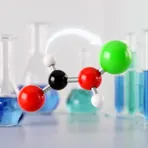
A chemical made from an acid when its OH group is replaced by a halogen like chlorine or bromine
Surface Forms
Morphology
The term is a transparent chemical compound name: 'acyl' (an acyl group) modifies 'halide' (a halogen-containing species), so the phrase denotes a halide derived from an acyl group (–COX), matching the given definition. Although technical vocabulary, the head–modifier noun composition is regular and predictable, so a learner who knows both constituents can infer the MWE meaning.
Etymology
Acyl halide names a molecule made of an 'acid' part and a halogen. The acyl is the acid piece and the halide is a halogen atom like chlorine that replaces the usual 'OH' in an acid. So imagine an acid where the 'OH' is swapped for chlorine, and that image explains why acyl halides react easily with water.

