
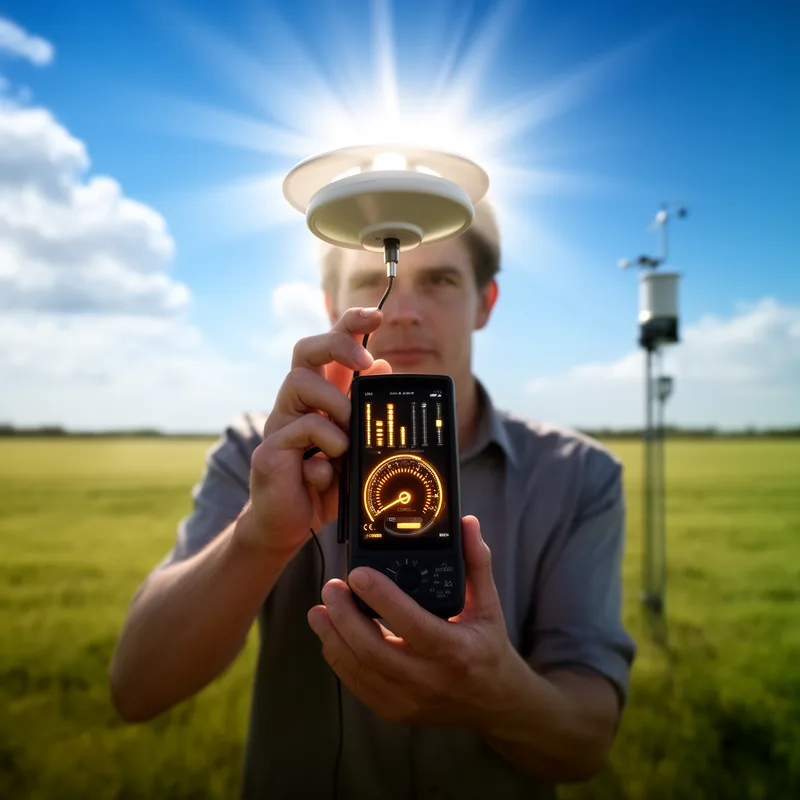
actinometry
- noun
- /ˌæktɪˈnɒmətri/
- Specialized
- The meteorologist used actinometry to record the daily solar radiation levels.
Examples
-
Researchers use actinometry to measure sunlight intensity.
-
Laboratories rely on actinometry to calibrate light sources with precise accuracy.
-
Advances in actinometry have helped scientists understand the effects of sunlight on climate change.
-
The study of actinometry is crucial for understanding solar energy.
-
Scientists employ actinometry for accurate measurement of sunlight intensity in their experiments.
-
In environmental studies, actinometry provides valuable data on how sunlight affects various ecosystems.
-
The use of actinometry has increased in recent years to monitor solar radiation patterns for climate research.
Synonyms

 1
8.0
1
8.0

A measurement of how bright light is

Measuring the amount and brightness of light
Surface Forms
Morphology
actinometry = actinometer (opaque) = actin + metry
The term is formed from the combining form 'actin-' and the technical suffix '-metry'; the combining form is not a transparent everyday English base and the meaning is specialized, so learners cannot reliably infer it.
Etymology
Actinometry is made of two Greek parts: actino- meaning 'ray' (think of a beam of light) and -metry meaning 'measure', as in thermometer. So actinometry is the measuring of rays, especially sunlight or other light radiation.