
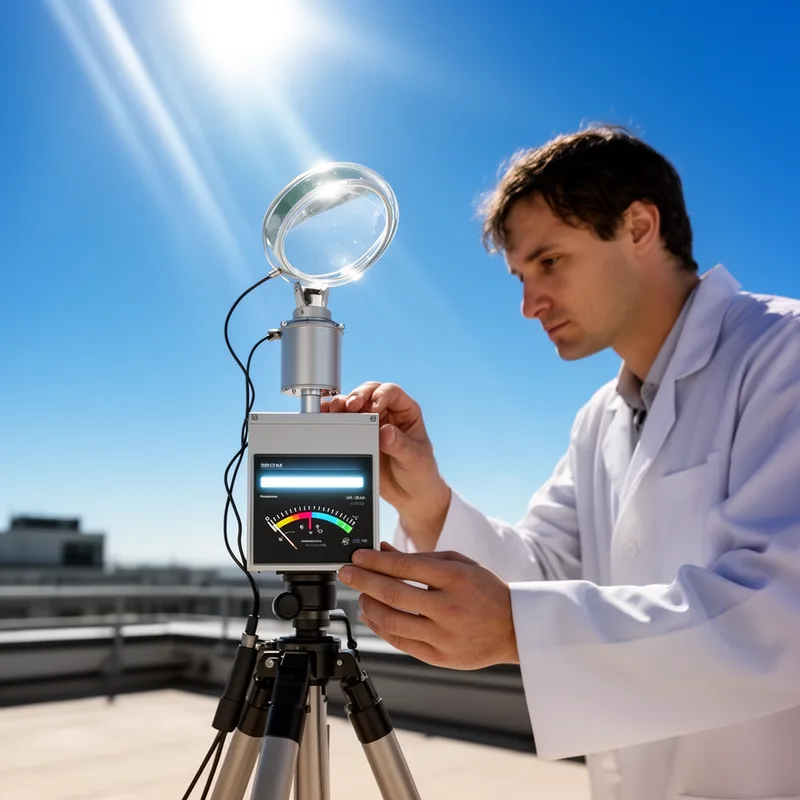
actinometer
- noun
- /ˌæktɪˈnɑːmɪtər/
- Specialized
- Before modern sensors, an actinometer was commonly employed to measure the intensity of sunlight in solar research.
Examples
-
Scientists used an actinometer to determine the amount of ultraviolet radiation reaching the surface.
-
The actinometer provided precise measurements crucial for the photochemical experiment.
-
Before modern sensors, an actinometer was commonly employed in solar research.
-
The actinometer measures sunlight intensity.
-
Scientists use an actinometer to assess UV radiation.
-
Scientists used an actinometer to measure the intensity of ultraviolet radiation reaching the Earth's surface.
-
The actinometer provided accurate readings necessary for understanding the effects of electromagnetic radiation on chemical reactions.
Synonyms

 1
8.5
1
8.5

A device that measures energy from light or heat
 1
4.2
1
4.2
A small device that measures light to help set camera settings
 1
9.9
1
9.9
A machine that measures how much light of different colors a substance absorbs to help know what it is


 1
8.6
1
8.6
A tool that measures how bright light is
 1
8.9
1
8.9
A machine that measures the light a substance gives off when it glows

A device that measures how much light there is at each color

A very sensitive device that measures tiny amounts of light or heat
A device that makes a small electric signal when light hits it to detect or measure light
A machine that measures light from chemical or biological reactions

A tool that measures light to set camera settings
Surface Forms
Morphology
Etymology
The word actinometer comes from the Greek aktis meaning 'ray' and the part -meter meaning 'measure', like in thermometer. So an actinometer is literally a tool that 'measures rays' or light, which is why it is used to measure radiation and sunlight.