
accelerando


 1
9.3
1
9.3
- noun
- /ˌæk.sə.ləˈræn.doʊ/
- Specialized
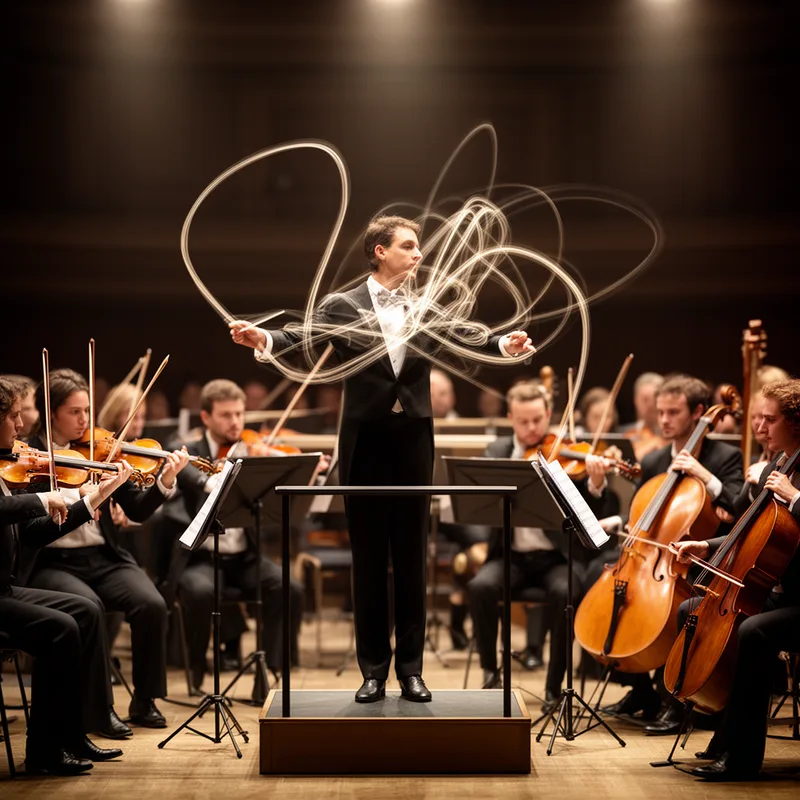
- The conductor signaled for an accelerando, and the orchestra began to play faster.
- accelerando and ritardando
Examples
-
A repertoire that helps explore the elasticity of time can be any piece that has an obvious ritardando or accelerando.
Academic text (2014) -
The Swedish folk dance "Fjaskern" (Hurry-Scurry) is a perfect example of a long, gradual accelerando (the music is found on Phyllis Weikart's Rhythmically Moving recordings).
Academic text (2014) -
Activity 3: Have students mirror your conducting of accelerando and ritardando.
Academic text (2014) -
Wrist movement is the quickest and surest way to begin and sustain an accelerando.
Academic text (2001) -
In "The Twelve Days of Christmas," we usually include an accelerando as we sing backward from 12 to 6, pause after 5, then accelerate again until the big ritardando in the last phrase.
Academic text (2014) -
It is more meaningful for young singers to experience a fermata, an accelerando, or a crescendo in their bodies and voices before it is diagrammed on a chalkboard or before they are required to memorize abstract terminology.
Academic text (1996) -
As the piece progressed, the musician smoothly performed an accelerando to build excitement.
-
The composer wrote an accelerando section to heighten the energy of the final movement.
Synonyms
 27
3.7
27
3.7
A faster speed at which something happens or grows

To play gradually faster in music
Antonyms

How Fast

Surface Forms
Morphology
accelerando = accelerate (semi-transparent) = accelerate + ando
Derived from the English verb 'accelerate' with the Italian suffix '-ando'; the lexical meaning is clear but the grammatical/adverbial or noun use is borrowed and the suffix is unfamiliar.
Etymology
Accelerando comes from Latin accelerare 'to make faster', the same root as accelerate, formed from ad- 'to' and celer 'swift', with the Italian ending -ando that shows an action. So an accelerando in music is 'an increase in speed' or a part that is played 'gradually moving faster'.