
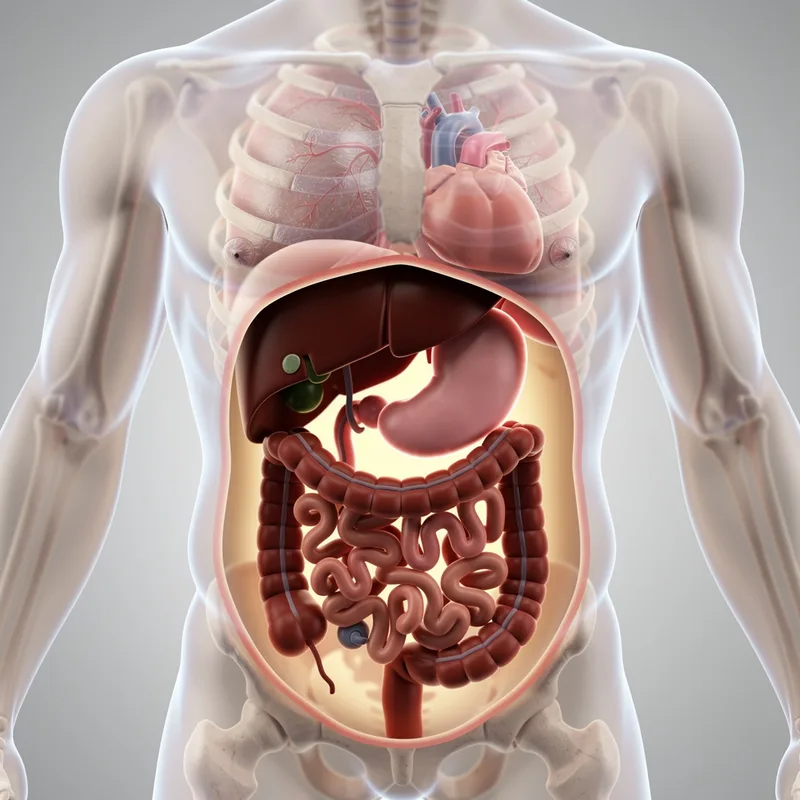
abdominal cavity
 5
5.1
5
5.1

- noun
- /æbˈdɑːmɪnəl ˈkævɪti/
- Specialized
- The doctor explained that the abdominal cavity holds vital organs like the stomach and intestines.
Examples
-
I opened the abdominal cavity and peered inside.
Fiction book (1998) -
We've been monitoring the internal grafts electronically and there is definitely new tissue growth happening in the abdominal cavity.
-
Most likely, it had already released poison into the abdominal cavity.
Fiction book (2001) -
The internal organs develop outside the body and cannot go into the abdominal cavity.
Blog text (4) -
The disease can also affect the lining of the abdominal cavity or the heart.
-
Investigation of upper half abdominal cavity reveals no free-flowing blood.
-
In very complicated cases, if the infection spreads to the abdominal cavity, it could be fatal.
Blog text (2) -
And as many of you ladies will soon find out, your abdominal cavity will expand to make room for the swelling uterus.
-
They're in the back part of your abdominal cavity, a space that's called the retroperitoneal position in your body.
-
With both methods, the disk portion of the tag remained inside the abdominal cavity, and the plastic streamer protruded externally (Fig. 4).
Academic text (1994)
Synonyms
 107
3.0
107
3.0
The part of the body between the chest and hips that contains the stomach and intestines
 1
8.6
1
8.6
A space inside the belly between thin tissue layers holding a small amount of fluid
Surface Forms
Morphology
The phrase is a straightforward adjective+noun composition: 'abdominal' (relating to the abdomen) + 'cavity' (a hollow or space), so the meaning 'the hollow/space in the abdomen containing internal organs' is directly inferable from the parts. This is a literal, cross-linguistically common anatomical construction that a B1 learner who knows both constituents would readily understand.
Etymology
The term abdominal cavity comes from a simple image: abdominal means 'belly' and cavity means a 'hollow' space. So it pictures the hollow space inside the body that holds the stomach, liver and intestines, which is why it means the large space that contains the body's main organs.