
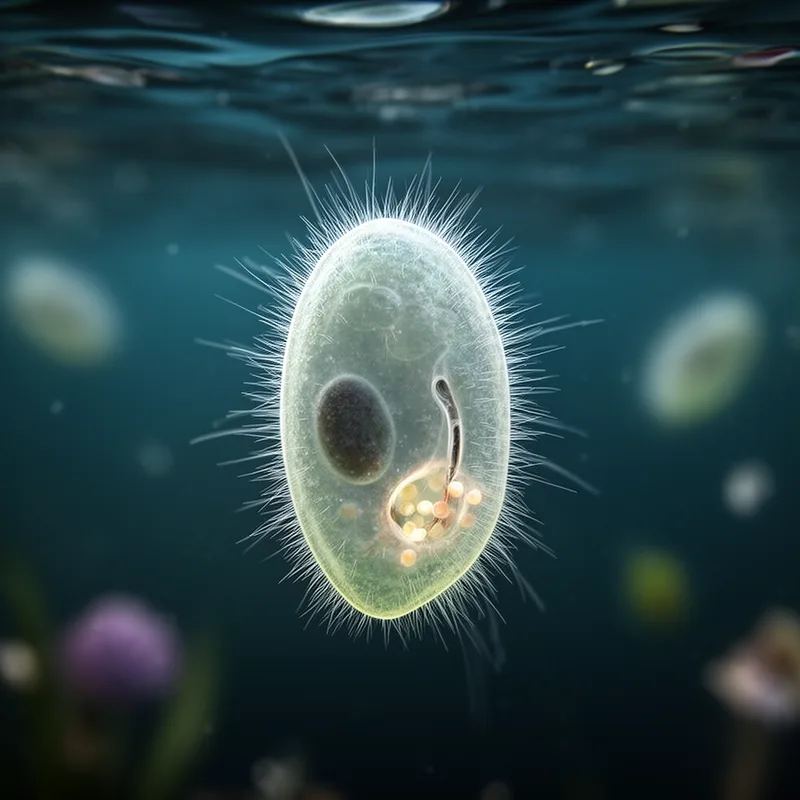
ciliate


 1
9.9
1
9.9
- noun
- /ˈsɪliˌeɪt/
- Specialized
- "Attacked" larvae have cysts on their cuticles; "invaded" larvae look like normal larvae, except that ciliates are visible inside their bodies.
- ciliates feeding
Examples
-
Under higher magnification, microplankton, such as diatoms and ciliates, become visible and are interesting to watch.
Academic text (2011) -
Within lakes of the McMurdo Dry Valleys, rotifers and predatory ciliates are the top consumers in the water column.
Academic text (1999) -
Larvae die from such ciliate infections in about three weeks.
Academic text (1992) -
With this convenient supply of ciliates, we repeated earlier experiments.
Academic text (1992) -
You didn't come to watch ciliates feeding.
Fiction book (2000) -
"The ciliates were raised in nutrient solution for thirty generations," she said, taking the slide out of the apparatus.
Fiction book (2000) -
In the Indo-Pacific region, it was suspected that the species H. corallasia was the cause of diseases in its coral areas, but it was shown that this ciliate belongs to another species.
Academic text (2018) -
The disease of the skeletal eroding band (SEB), which manifests as dense aggregations of the ciliate H. corallasia, is confused with diseases of the black band.
Academic text (2018) -
A ciliate uses its hair-like organelles to swim swiftly through the water.
-
Scientists studied how ciliates feed by using their cilia to capture tiny particles.
Synonyms

A single cell living thing that uses tiny hairs to move and eat

A single-celled animal with many tiny hairs called cilia that it uses to move and eat
Surface Forms
Etymology
The noun ciliate is named after Latin cilia ('eyelashes' or 'small hairs') because these single-celled creatures are covered in tiny hair-like cilia. Those hairs help the ciliate move and feed, which is why the name fits.