
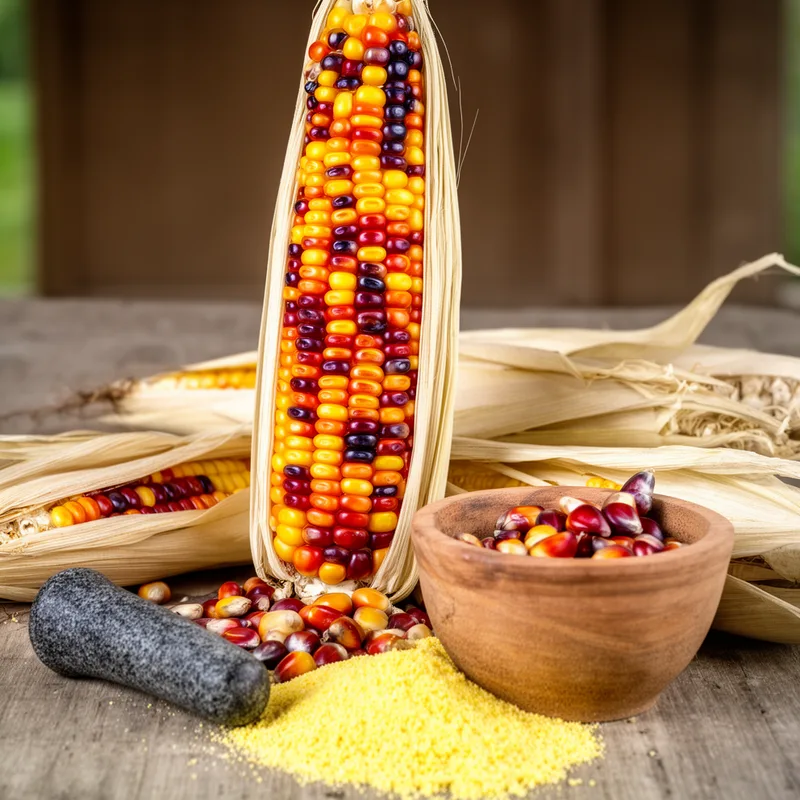
Zea mays indurata
- noun
- Specialized
- Thanks to its hard kernels, Zea mays indurata is often ground to make hominy or cornmeal.
Examples
-
The decorative multicolored ears sold in autumn are usually Zea mays indurata rather than sweet corn.
-
Did you know that Zea mays indurata is also called flint corn?
-
Farmers in the region often plant Zea mays indurata because it resists spoilage better than other corn varieties.
-
Farmers in the Midwest often grow Zea mays indurata for its durability.
-
Farmers in the region often plant Zea mays indurata because it resists spoilage better than other corn varieties.
-
Thanks to its hard kernels, Zea mays indurata is often ground to make hominy or cornmeal.
-
The decorative multicolored ears sold in autumn are usually Zea mays indurata rather than sweet corn.
Synonyms

 1
4.2
1
4.2

A type of corn with hard kernels in many colors used for decoration or food

A type of corn with a hard outer layer and a soft inside
A type of corn with hard outer kernels and a soft inside used for food or decoration
A type of corn with hard outer kernel and softer inner part
Surface Forms
Morphology
Zea + mays + indurata
This is a Latin binomial (genus + species/varietal epithet) that is compositionally informative: if a learner knows 'Zea' = maize and understands 'indurata' as 'hardened' (indurate), they can infer a hardened/ flint variety of maize. However, the constituents are Latin taxonomic forms rather than everyday English words and two constituents are not ordinary lexical items for a B1 learner, so the meaning is only partially predictable.
Etymology
Zea mays indurata comes from Latin words: Zea mays means corn and indurata comes from a word meaning 'hardened'. So the name gives the image of corn with a hard outer shell on each kernel, which is why it refers to 'flint corn', a corn with very hard kernels used for food and decoration.