
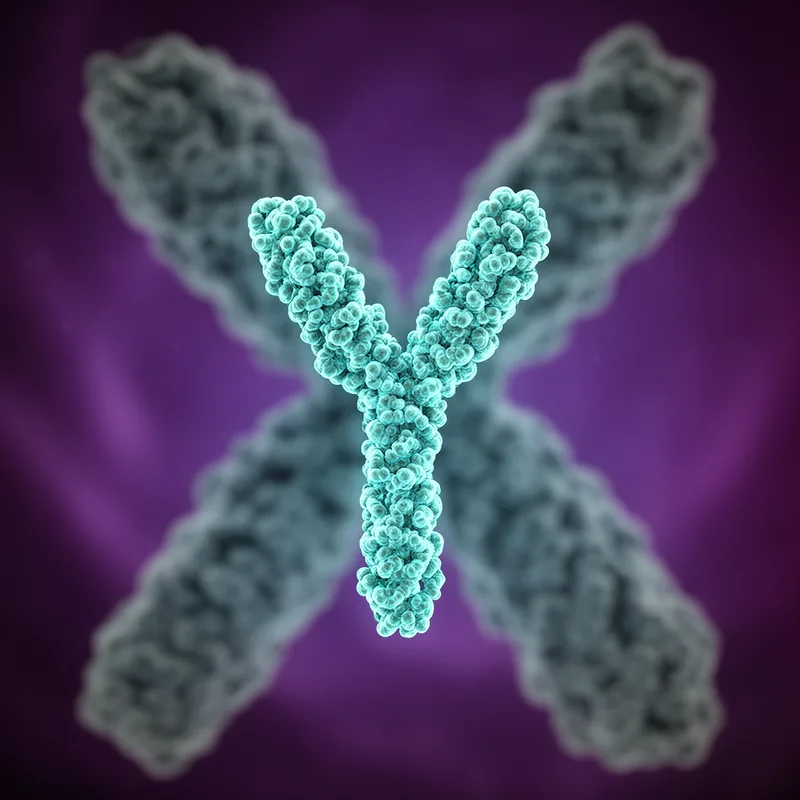
Y chromosome
 7
5.5
7
5.5

- noun
- /waɪ ˈkrɒməsəʊm/
- Specialized
- During this time, the Y chromosome became increasingly distinctive and isolated.
- gene on the Y chromosome
- X and Y chromosome
- male Y chromosome
Loading YouTube…
Watch on YouTubeBut now we can also do what's known as Y DNA testing, which is just looking at DNA from the Y chromosome, and you can amplify that up with the PCR.
- But now we can also do what's known as Y DNA testing, which is just looking at DNA from the Y chromosome, and you can amplify that up with the PCR.
Examples
-
Monotremes do have Y chromosomes, and the males develop a penis and testicles and produce sperm.
Academic text (2002) -
But the future of the Y chromosome seems clear.
Academic text (2002) -
So the male would have had a white Y chromosome paired with that.
-
That Y chromosome, that tiny little Y chromosome makes a big difference.
-
The second cell expressing CD45 contains the Y chromosome, and thus is male.
Academic text (2003) -
All the genes on the Y chromosome probably have only a few million years left before they vanish.
Academic text (2002) -
If you have one X chromosome and one Y chromosome, your ratio is 2:1, and you're male.
Blog text (8) -
For example, many of these male-building genes on the Y chromosome began to be expressed in the testicles and nowhere else.
Academic text (2002) -
There are 22 pairs of human chromosomes; males have an X and Y chromosome while females have two X chromosomes.
Academic text (1992) -
The Y chromosome is responsible for determining male biological characteristics in humans.
Surface Forms
Morphology
Y + chromosome
A B1 learner who knows 'Y' as a letter and 'chromosome' as a cellular structure can transparently infer this is a particular kind or label of chromosome (i.e., a chromosome called 'Y'). However, the specific biological role — that it is the male sex chromosome and determines male characteristics — is not derivable from the letter 'Y' itself and requires domain knowledge or exposure, so the expression is only partially predictable.
Etymology
Y chromosome gets its name from early scientists who labelled the two sex chromosomes X and Y, and they may have chosen the letter Y simply as the partner to X. Because the small Y is passed from 'father' to 'son' and carries male traits, Y chromosome now means the male sex chromosome.