
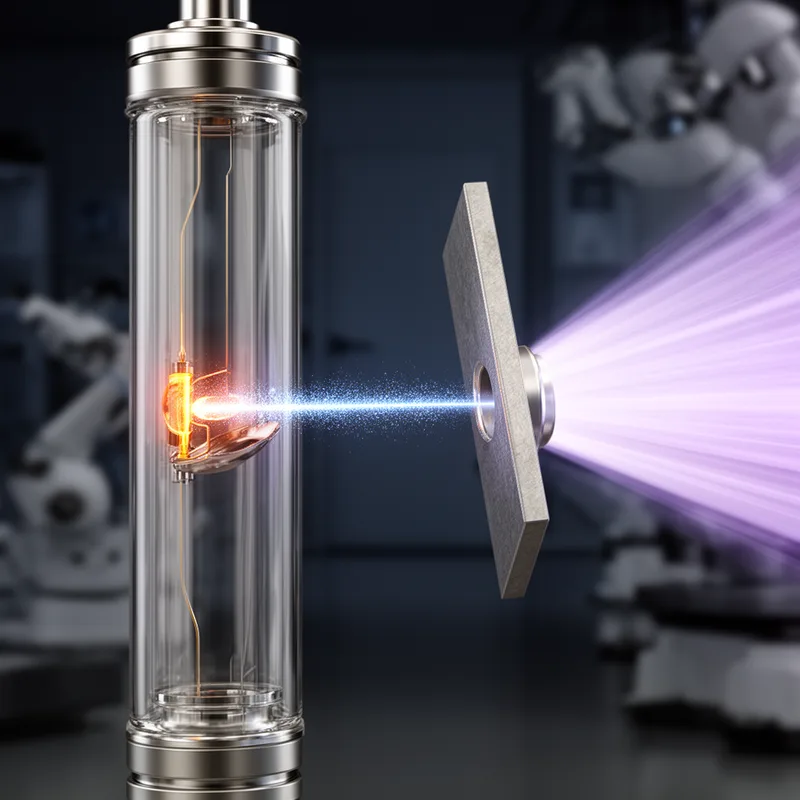
X-ray tube
- noun
- /ˈɛksˌreɪ tuːb/
- Specialized
- The X-ray source was an Oxford Instruments 100 W Neptune X-ray tube with a rhodium (Rh) target.
Examples
-
Ordinary planar x-ray images are formed by placing a patient between an x-ray tube and an image receptor, usually a cassette containing an intensifying screen and a photographic film.
Academic text (1995) -
So I want to show you that the modern X-ray tube is the result of improvements made by an MIT alum, MIT alum, and his name was William Coolidge.
-
A designated spot on an artifact is subjected to high energy produced by an X-ray tube.
Academic text (2003) -
And then on the other side, this is the X-ray tube and it also just unplugs if I can get a handle on it here and there we are.
-
In the 1880s, Crookes also developed the prototype of the modern x-ray tube.
Academic text (1995) -
Pellets were analyzed on a Philips PW2404 XRF spectrometer with a Rh-anode X-ray tube.
Academic text (2018) -
The dentist used an X-ray tube to examine the patient's teeth for cavities.
-
During the experiment, the researchers relied on the X-ray tube to generate the necessary radiation for their analysis.
-
The X-ray machine was equipped with a modern X-ray tube that improved the quality of the diagnostic images.
Surface Forms
Morphology
The meaning is directly compositional: combining 'X-ray' (the type of radiation) with 'tube' (a device) yields a tube used for or producing X-rays. A B1 learner who knows both constituents can infer it is the device/component related to X-rays even if they lack technical details. This follows standard noun-noun compounding and is cross-linguistically transparent.
Etymology
X-ray tube names a simple device: it is a glass or metal tube where a beam of fast electrons hits a metal target and makes X-rays. So the name literally means 'a tube that produces X rays'.

