
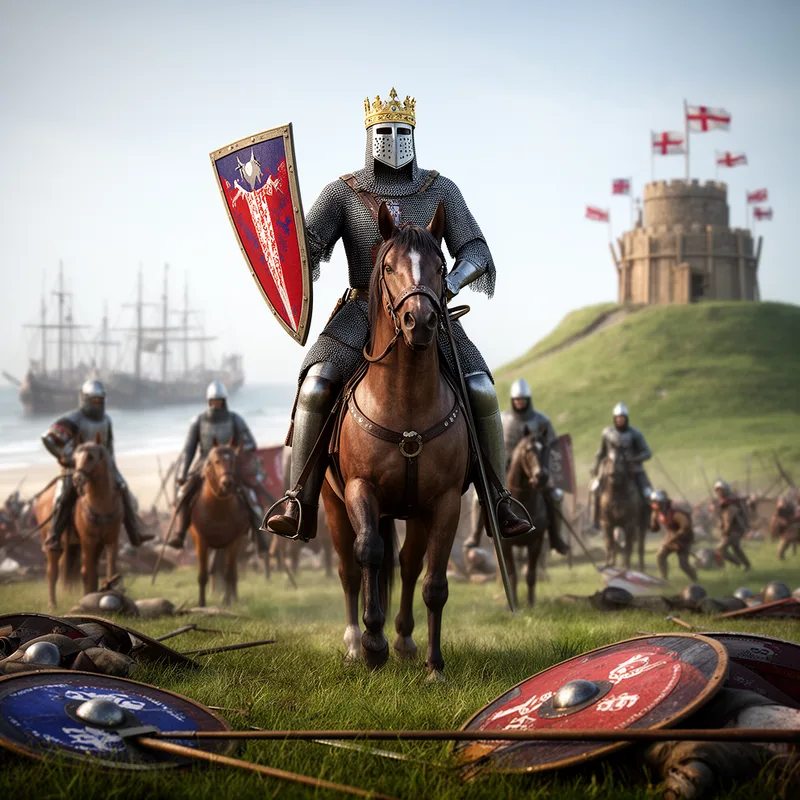
William I


 1
6.7
- proper noun
- William I's reign marked the beginning of significant Norman influence on English culture.
Examples
-
The Domesday Book was commissioned by William I to assess the wealth of his new kingdom.
-
William I is often remembered for his decisive victory at the Battle of Hastings in 1066.
-
William I was crowned in Westminster Abbey.
-
Did William I really defeat Harold II?
-
William I is often remembered for his decisive victory at the Battle of Hastings in 1066.
-
William I's reign marked the beginning of significant Norman influence on English culture.
-
The Domesday Book was commissioned by William I to assess the wealth of his new kingdom.
Synonyms
 3
7.9
A ruler from Normandy who becomes the first Norman king of England after invading in 1066
Surface Forms
Morphology
William + I
The sequence 'William I' can be parsed compositionally as the name 'William' plus the ordinal marker 'I' (Roman numeral for 'the First'), so a learner who recognises Roman numerals will understand it means 'William the First'. However, the detailed historical identity and role (that he is the first Norman King of England, William the Conqueror) are not derivable from the constituents alone, so the expression is only partially transparent to a B1 learner.
Etymology
William I is the first King William of England, often called 'William the Conqueror' because he came from Normandy and won the Battle of Hastings in 1066. The 'I' shows he was the first King named William, and his rule brought many Norman customs and the Domesday Book to record the country's wealth.