
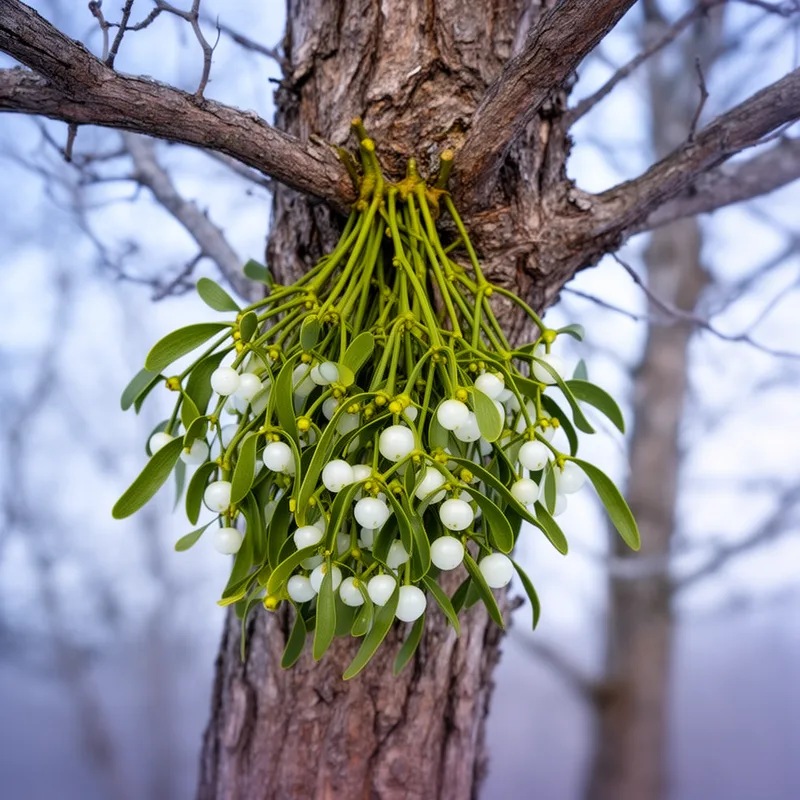
Viscum album
- noun
- UK
 :
Viscum album
:
Viscum album
- The glistening white berries of Viscum album are easily spotted in winter.
Examples
-
Botanists study the way Viscum album attaches itself to the branches of host trees.
-
The tradition of kissing under the Viscum album dates back centuries in Europe.
-
Look at the Viscum album!
-
I found some Viscum album in the garden.
-
The glistening white berries of Viscum album are easily spotted in winter.
-
The tradition of kissing under the Viscum album dates back centuries in Europe.
-
Botanists study the way Viscum album attaches itself to the branches of host trees.
Synonyms
 40
4.1
40
4.1

A small green plant with white berries that people hang in doorways at Christmas
A European plant that grows on other trees with green branches, thick leaves, and white berries used at Christmas
Surface Forms
Morphology
Viscum + album
This is a Latin binomial: if a learner knows 'Viscum' (a parasitic shrub) and recognizes 'album' as meaning 'white' (Latin/alb-), they can infer it denotes a white form/species of Viscum and so partially grasp the referent. However, because it is a scientific name (not everyday compositional English) and many learners will not know the Latin adjective or the link to the common name 'mistletoe', the full, conventional meaning is not fully predictable from the parts.
Etymology
Viscum album gets its Latin name from Viscum and album: Viscum meant a sticky substance from its berries and album means 'white'. The berries are very sticky, so their seeds attach to tree branches and the plant lives on other trees. Those bright white berries are easy to see in winter, so people used it as the Christmas mistletoe and for 'kissing under the mistletoe', which is why we still know it today.