
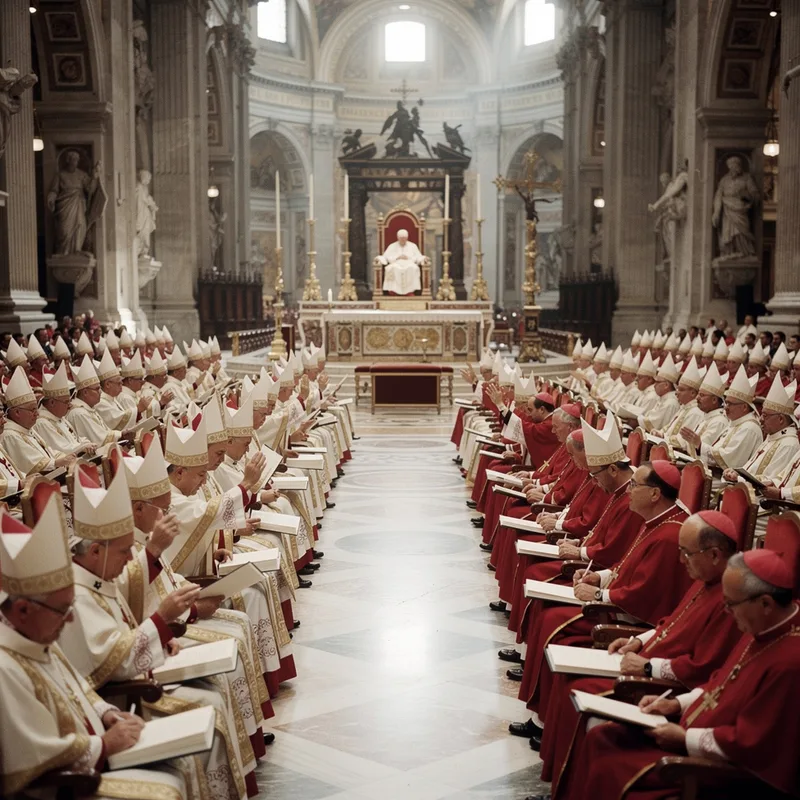
Vatican II
 5
7.4
5
7.4

- proper noun
- /ˈvætɪkən tuː/
- During the Second Vatican Council (Vatican II), the Catholic Church experienced a dramatic revolution.
- ecumenical decree of Vatican II
- Vatican II documents
- legacy of Vatican II
Examples
-
Almost immediately, the commitments of Vatican II were also being implemented by the newly empowered bishops.
Academic text (1996) -
The Fathers of Vatican II stated that Christians must not separate faith and life.
Academic text (2002) -
Reception of Vatican II within the Catholic Church varies by topic and geographical location.
Academic text (2013) -
The church, despite its aggiornamento (updating) in Vatican II, is still a hierarchical, centralized, and rigid institution.
Academic text (1999) -
Vatican II introduced reforms that changed the way many Catholics practiced their faith.
-
Many believe that the decisions made during Vatican II have shaped modern Catholicism significantly.
-
The teachings of Vatican II emphasized the importance of dialogue with other Christian denominations.
Synonyms
 5
6.3
5
6.3
A meeting of Catholic Church leaders from 1962 to 1965 that changed worship and encouraged talks with other Christian churches
Surface Forms
Morphology
The constituent 'Vatican' signals the Roman Catholic center and 'II' clearly marks 'second', so a learner who knows both parts can infer this refers to a second Vatican-related event or entity. However, the specific reference to the Second Vatican Council and its reforming actions is a conventional proper-name usage that is not fully predictable from the parts alone, so full meaning requires cultural or encyclopedic knowledge.
Etymology
Vatican II, made of Vatican and II, comes from the Second Vatican Council, a large meeting of Catholic bishops from 1962 to 1965 that made important changes like using local languages in Mass and encouraging churches to work together. So today Vatican II usually means that meeting and the 'spirit of reform' it started.