
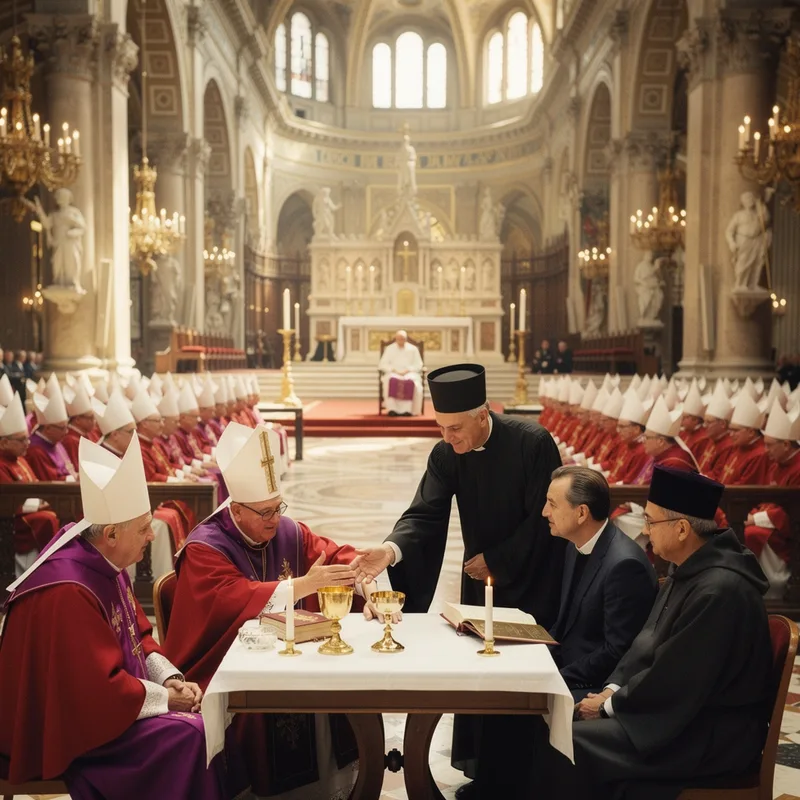
Second Vatican Council
 5
6.3
5
6.3

- noun
- /ˈsɛkənd ˈvætɪkən ˈkaʊnsl/
- The Second Vatican Council was a pivotal event for the Roman Catholic Church, taking place from 1962 to 1965.
- legacy of the Second Vatican Council
- documents of the Second Vatican Council
- Second Vatican Council, Dogmatic Constitution
Examples
-
His observations on Christian unity, in some respects, anticipate the directions of the Second Vatican Council.
Academic text (1990) -
The documents on religious pluralism from the Second Vatican Council also make such an attempt.
Academic text (1999) -
While I was in college, the Second Vatican Council took place.
Academic text (2014) -
I was also excited about the Second Vatican Council.
Academic text (2014) -
The ecumenical enthusiasm of the decades after the Second Vatican Council is over.
Academic text (2013) -
The 50th anniversary of the opening of the Second Vatican Council also takes place on Oct. 11.
Blog text (30) -
Published theological works on Guadalupe have increased remarkably in the decades since the Second Vatican Council.
Academic text (2009) -
The NCCB and the USCC were established in 1966, just after the Second Vatican Council.
Academic text (1993) -
Thirty years after the Second Vatican Council, the Catholic Church is still exploring the practical implications of inculturation.
Academic text (1996) -
The bilateral dialogues emerging between churches after the Second Vatican Council followed the same faith and order agenda.
Academic text (2015)
Synonyms
 5
7.4
5
7.4
A meeting of Catholic bishops from 1962 to 1965 that made major church reforms
Surface Forms
Morphology
A B1 learner who knows '2nd' (ordinal), 'Vatican' (the Vatican as the Church/state center) and 'council' (an assembly) can infer that this refers to the second formal assembly held by the Vatican. They might not know the exact dates or specific reforms, but the core meaning—the Vatican's second church council—is transparently derivable from the constituents.
Etymology
The name Second Vatican Council literally means the second big meeting, a council, of Catholic bishops at the Vatican. In the 1960s these bishops met to change how the Church worked, so today the phrase refers to those important 'reforms', like using local languages instead of Latin and opening talks with other Christian groups.