
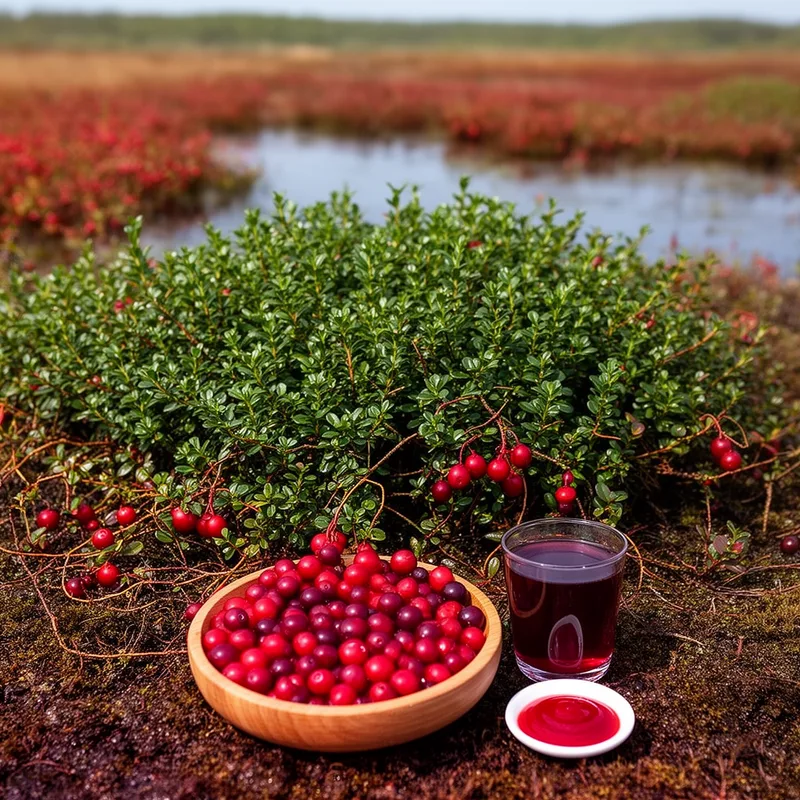
Vaccinium macrocarpon
- noun
- /ˌvækɪˈniːəm ˌmækroʊˈkɑːrpɒn/
- Specialized
- Vaccinium macrocarpon, commonly known as the American cranberry, is a plant native to North America that produces tart red fruits.
Examples
-
Vaccinium macrocarpon is cultivated extensively for its tart, red berries used to make juice and sauce.
-
The wetlands of North America provide an ideal habitat for Vaccinium macrocarpon.
-
Many commercial cranberry products are derived from Vaccinium macrocarpon varieties.
-
The Vaccinium macrocarpon grows well in wetlands.
-
Farmers harvest Vaccinium macrocarpon every fall.
-
The fruit of Vaccinium macrocarpon is often used in traditional recipes for cranberry sauce during Thanksgiving.
-
Vaccinium macrocarpon thrives in acidic, sandy soils, making it ideal for cultivation in certain regions of North America.
Synonyms

 28
1.3
28
1.3

A low evergreen bush that has small red berries used for cooking

A low North American plant that makes red berries people use for sauce and juice

A low plant with small red berries used for sauces and juice
Surface Forms
Morphology
Vaccinium + macrocarpon
The genus name Vaccinium is informative (a group including blueberries/cranberries), but 'macrocarpon' is not a common English word and is listed as not found in the dictionary; only a learner with knowledge of Latin/Greek morphemes (macro- 'large' + -carpon 'fruit') could infer 'large‑fruited Vaccinium'. Because understanding the precise referent (the American cranberry) requires botanical or taxonomic knowledge and familiarity with Latin binomials, the transparency is partial rather than fully transparent or fully opaque.
Etymology
Vaccinium macrocarpon is the scientific name for the American 'cranberry'. The name uses old word parts macro meaning 'large' and carpon meaning 'fruit' to show the plant's red berries, so the name points to the 'cranberry' we eat today.