

American cranberry
- noun
- /əˈmɛrɪkən ˈkrænˌbɛri/
- US
- Wild American cranberry bushes grow in the bogs of New England and Canada.
Examples
-
The tart flavor of the American cranberry makes it perfect for sauces and juices.
-
Farmers harvest American cranberries in autumn using special wetland techniques.
-
The American cranberry is rich in antioxidants.
-
I love making sauce with American cranberries for Thanksgiving.
-
The chef made a delicious sauce using fresh American cranberries for the holiday feast.
-
She added American cranberries to the salad for a burst of flavor and color.
-
I enjoyed a refreshing drink made from American cranberries during the summer barbecue.
Synonyms

 28
1.3
28
1.3

A low evergreen bush that has small red berries used for cooking

A low North American plant with trailing stems and red berries used for juice and sauce
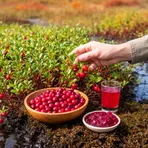
A low North American plant that makes red berries people use for sauce and juice
How Big

Surface Forms
Morphology
The meaning is directly compositional: 'American' specifies origin or association and 'cranberry' names the berry, so the phrase denotes a cranberry linked to America. This straightforward adjective + noun combination follows common cross-linguistic patterns, so a B1 learner who knows both words should understand it.
Etymology
American cranberry probably comes from an older word craneberry, because early settlers thought the flower and long stem looked like a crane's neck and beak. That's why the name joins the bird image crane and the small red berry from North America that people 'eat' or 'cook with'.