
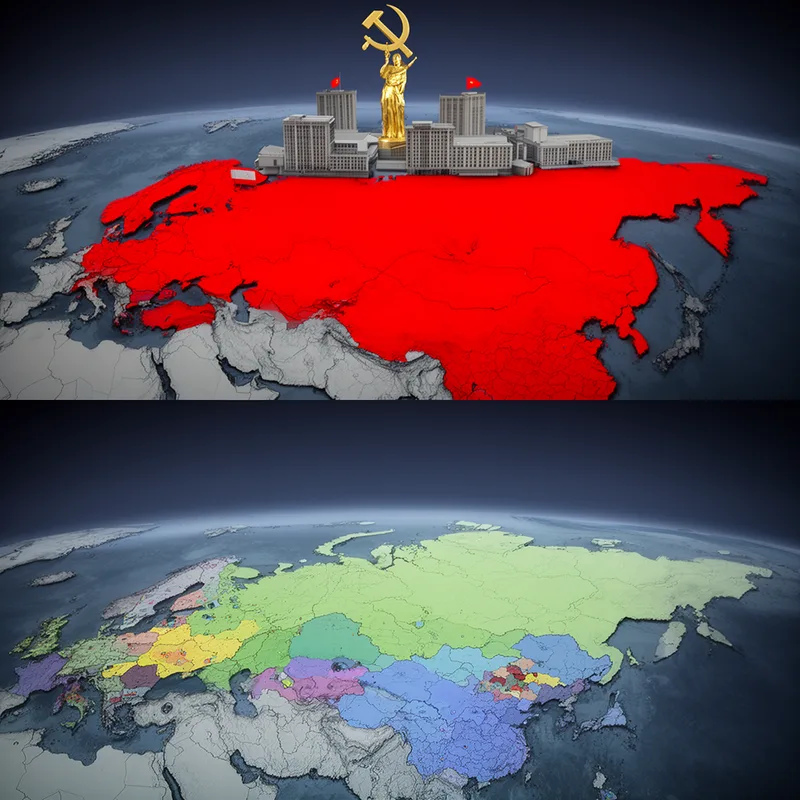
Union of Soviet Socialist Republics
- proper noun
- The Union of Soviet Socialist Republics was known for its significant impact on global politics during the 20th century.
Examples
-
The Union of Soviet Socialist Republics was dissolved in 1991 after years of political turmoil.
-
After that war, the world split into two competing spheres of influence: that of the United States of America and that of the Union of Soviet Socialist Republics.
Academic text (2015) -
ASFV isolate O-77, which was isolated in 1977 from Odessa, Ukraine (at the time, part of the Union of Soviet Socialist Republics), was used in this study.
Academic text (2015) -
Many countries formed alliances during the Cold War to counter the influence of the Union of Soviet Socialist Republics.
Synonyms

 ∞
3.8
∞
3.8

A former country of several republics in eastern Europe and northern Asia, including Russia, that existed from 1922 to 1991
 45
3.8
45
3.8
A former union of communist republics in eastern Europe and northern Asia
Surface Forms
Morphology
union + of + Soviet + socialist + republic
This is a literal, compositional name: combining 'union' + 'of' + 'Soviet' + 'socialist' + 'republics' directly describes a political union composed of socialist republics labeled 'Soviet'. The structure and meaning are cross-linguistically common, so a B1 learner who knows the constituent words can infer the basic referent (a political entity made of Soviet socialist republics), even if they may lack historical detail.
Etymology
Union of Soviet Socialist Republics is a literal label: a union (a joining) of soviet (local 'council') socialist (a system that tries to 'share things more equally') republics ('countries'). So the name describes the country formed when many councils and republics joined under socialist ideas, and it became the official name of the USSR.