

Soviet
 ∞
5.4
∞
5.4

- adjective
- /ˈsoʊviət/
- During the cold war, tensions ran high between the United States and the Soviet Union.
- Soviet Union
- Soviet era
- Soviet leaders
Loading YouTube…
Watch on YouTubeBut the Polish Soviet war was not yet over.
- But the Polish Soviet war was not yet over.
- He fought, you know, against the Soviet troops in Afghanistan.
- So they would have ended up murdering huge numbers of Soviet citizens as well.
- And Georgia is a former Soviet satellite and all this stuff.
- And it's, it's, it's, it's one of the very best Soviet films, if that's even the word.
- Essentially, our goal should be about containing Soviet aggression.
- The effects on Soviet trade are substantial.
- But the education system for like, for younger kids in the Soviet Union was incredible.
- It was given to them by Soviet, Soviet sympathizers in the West.
- Yeah, I mean, vintage USSR Soviet striking board clock.
Examples
-
She grew up in in the depths of Soviet Communist Russia.
-
But you can see these these old these old Soviet era books are really hardcore.
-
But this was Soviet era, the bad old days.
-
Though it took a few years, Soviet troops finally left Poland.
-
Look, chess was very popular in the Soviet Union and being world champion.
-
For once, the US and Soviet Union were united in condemnation.
-
My partner and I were on the eastern border monitoring Soviet military transmissions.
-
Yet the press assumed that this meant Soviet superiority in technology.
-
Soviet bombers used them to confuse American radar during the cold war.
-
International subjects constituted a dominant theme on Soviet stamps in the 1980s and earlier.
Academic text (2011)
Compounds
 ∞
3.8
∞
3.8
A former country of several republics in eastern Europe and northern Asia, including Russia, that existed from 1922 to 1991

 1
5.2
1
5.2
A large country that was the main part of the former Soviet Union covering eastern Europe and northern Asia
- Formal
Long-lasting political, social, and cultural effects that continue because of the Soviet Union
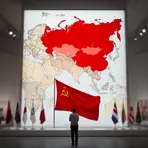
The largest republic of the former Soviet Union, covering much of eastern Europe and northern Asia from 1917 to 1991
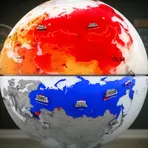
A large republic of the former Soviet Union covering much of eastern Europe and northern Asia, now Russia

- Slang
A joking name for Canada that imagines it as a country run like the Soviet Union


A former large country in eastern Europe and northern Asia with a communist government
Surface Forms
Etymology
Soviet comes from the Russian sovet, which means 'council' or 'advice' and is like the English word 'council'. It was first used for local workers' and soldiers' councils after 1917, so Soviet came to mean 'of the councils' and later 'of the USSR'.