
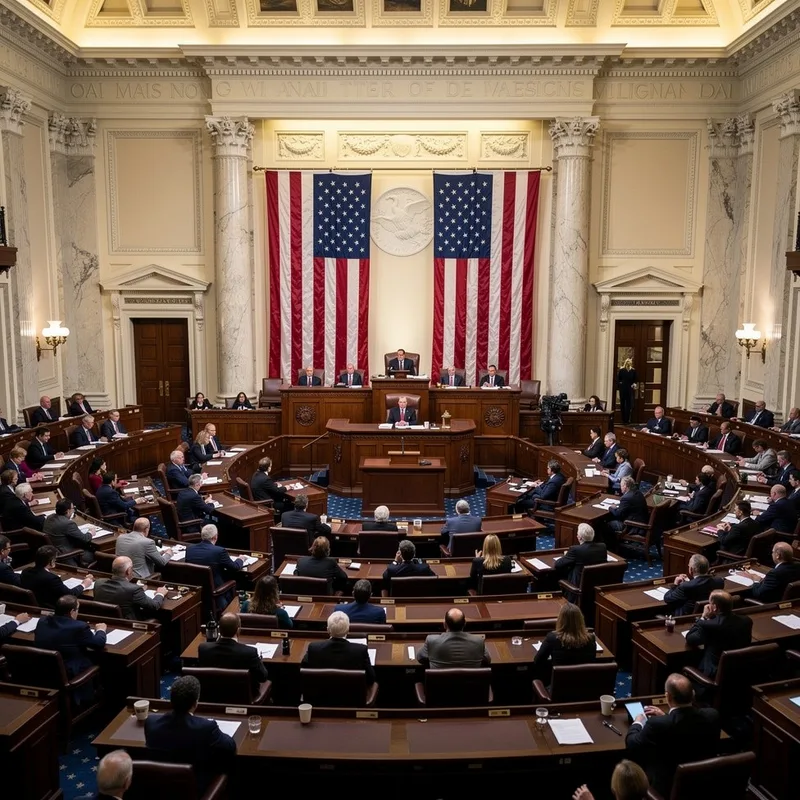
US Congress
 10
3.0
10
3.0

- proper noun
- /juː ɛs ˈkɒŋɡrɛs/
- Formal
- The US Congress is responsible for making federal laws in the United States.
- US Congress passed
- US Congress enacted
Loading YouTube…
Watch on YouTubeIt has the effect, now much remarked in the US Congress, of defining compromise as betrayal.
- It has the effect, now much remarked in the US Congress, of defining compromise as betrayal.
- India's had a lot to say about the behaviour of tech firms within its border, and of course, the US Congress has been making efforts to cap big tech scale and power.
- Analysis is that the US Congress does not have the power to regulate abortion on a national basis post Dobbs.
- the US Congress is trying to pass the Hong Kong Human Rights and Democracy Act, but that's kind of just like a broad condemning of human rights violations.
- And indeed, at the time, the head of defense appropriations in the US Congress didn't much like mathematics.
- Are there lessons, particularly for aspiring leaders, current leaders, or even the US Congress?
Examples
-
Americans are now questioning the US Congress about what they are doing to correct this unsustainable relationship with India.
Blog text (3) -
Be that as it may, the US Congress is in the process of passing laws that regulate the use of social media for children and adolescents.
-
the US Congress funded this research.
-
The Healthy Families Act, under consideration in the US Congress, would mandate the provision of paid sick leave for employees.
Academic text (2012) -
Before 2007, US Congress approval ratings had been below 20 percent only twice: in 1979 and 1992.
Blog text (10) -
In 1991, the US Congress finally passed the Radiation Exposure Compensation Act, also known as RECA.
-
In response to the overturning of the CPPA, the US Congress passed into law the PROTECT Act of 2003.
Academic text (2015) -
We used age 60 years as the measure of when a person is "old" because that is the age recognized by the US Congress in the Older Americans Act as the point at which people are likely to need services to support independence and long-term care needs.
Academic text (2013) -
Peter Hakim, Staff Director of the Inter-American Dialogue, emphasized this point in his statement to the US Congress on the EAI.
Academic text (1992) -
The broader strategies, of course, were not appealing enough to ensure ratification of the Equal Rights Amendment to the Constitution, which passed both houses of the US Congress in 1972 but failed to achieve ratification by the necessary thirty-eight states before its 1982 deadline.
Academic text (2011)
Synonyms
 356
5.3
356
5.3
A group of people who make and change the laws of a country or region
 28
2.5
28
2.5
The part of the United States government that makes laws, made of the Senate and the House of Representatives
 24
2.5
24
2.5
A national group of elected people who make United States laws and includes the Senate and House of Representatives
 14
3.6
14
3.6
The part of government that makes laws
 3
2.7
3
2.7
Group in the United States government that makes national laws and includes the Senate and the House of Representatives
Surface Forms
Morphology
The meaning is directly compositional: 'US' identifies the United States and 'Congress' names a legislature, so together they straightforwardly mean the legislature of the United States. This noun‑noun naming pattern is transparent and cross‑linguistically common, so a B1 learner who knows both constituents would readily understand it.
Etymology
US Congress comes from the word congress, which once meant a 'coming together' or 'meeting' of people. That's why US Congress is the national group of elected people who gather to make laws.