
Trojan War
 4
7.2

- proper noun
- /ˈtroʊdʒən wɔr/
- Literature
- They fought in the legendary Trojan War, and their grand army invaded Athens.
Loading YouTube…
Watch on YouTubeAnd we know that Agamemnon was killed when he got back from the Trojan War.
- And we know that Agamemnon was killed when he got back from the Trojan War.
- And this is actually populated by people taken from ancient Greece around the time of the Trojan War.
- And then I realized it was the travails of Odysseus trying to get back to Ithaca after the Trojan War.
- Interestingly though, this is a scene which isn't described in the literary texts about the myth of the Trojan War.
- It doesn't have to be about the Trojan War, you know, doesn't have to be the Iliad.
- I tend to go for the classics, so I keep you reading The Iliad by Homer with the Trojan War.
Examples
-
Odysseus never returned home from the Trojan War.
-
When Odysseus went off to fight in the Trojan War, he entrusted his son Telemachus to the care of his friend and adviser, whose name was Mentor.
Academic text (2000) -
Can someone tell me how the Trojan War began?
-
And that's how the Trojan War began.
-
Tomorrow, I want papers from all of you on The Pride of Agamemnon and the role it played in extending the Trojan War.
-
I've been drawn into Homer's world of the Trojan War since my undergraduate days.
Blog text (17) -
He names the love goddess winner and soon goes to Sparta to claim his prize, thus setting the Trojan War in motion.
Academic text (2012) -
The Cretans contributed "80 black ships" to the Trojan War—one of the largest contingents—as noted in the Iliad.
Academic text (2010) -
In the Odyssey, part two of Homer's epic saga about the Trojan War and its aftermath, Odysseus, the conquering warrior-hero, experiences more than a few delays as he tries to get back home following the war.
Blog text (18) -
The Iliad details the events and heroes of the Trojan War as told by Homer.
Surface Forms
Morphology
The meaning 'the war involving Troy/the Trojans' is directly and compositionally derivable from 'Trojan' (related to Troy) + 'war' (armed conflict). Although it names a specific mytho-historical event, the pattern of naming wars after participants/places is common cross-linguistically, so a B1 learner who knows both constituents would understand its meaning.
Etymology
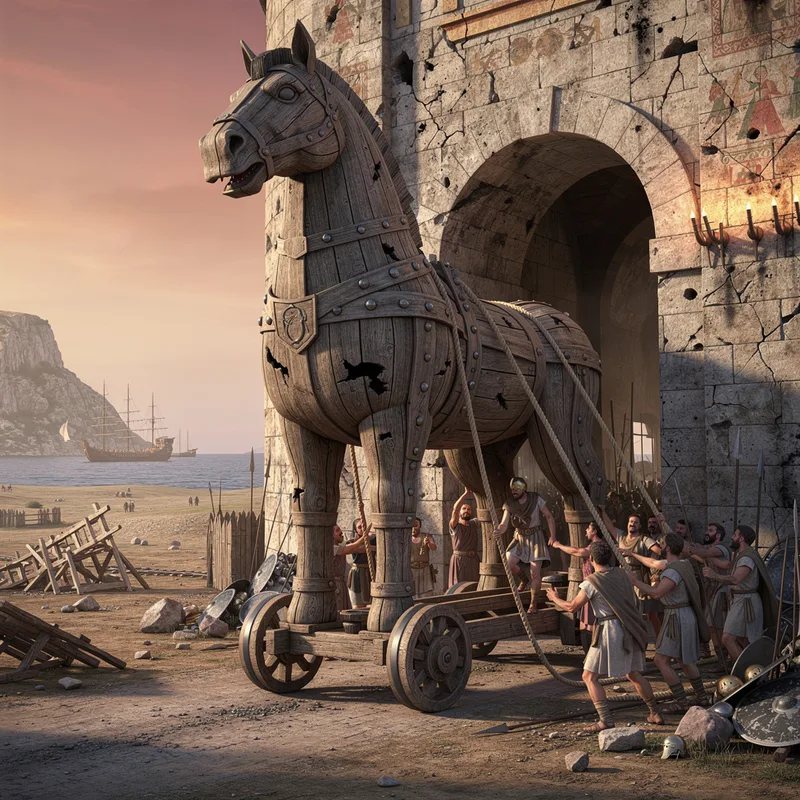
Trojan War comes from an ancient Greek story about a long, ten-year fight between the Greeks and the people of Troy after Prince Paris took Helen. The Greeks finally won by hiding soldiers inside a large wooden 'Trojan Horse', so Trojan War now means that famous, long war and is remembered for that clever trick.