

Tineola bisselliella
- noun
- Specialized
- Tineola bisselliella larvae are notorious for damaging woolen clothing stored in closets.
Examples
-
A sudden infestation of Tineola bisselliella led to holes in several historic garments.
-
The museum took precautions against Tineola bisselliella when setting up the textile exhibition.
-
The Tineola bisselliella is often found in closets.
-
Have you seen a Tineola bisselliella in your home?
-
Tineola bisselliella larvae are known for causing damage to sweaters and blankets stored for the season.
-
Many people use moth traps to catch Tineola bisselliella and protect their wool garments.
-
Tineola bisselliella can be particularly troublesome in humid environments where they thrive.
Synonyms
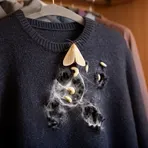
A small pale insect whose young make webs and eat clothes
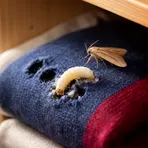
A small insect whose young eat wool and make holes in clothes
Surface Forms
Morphology
Tineola + bisselliella
The binomial form signals a scientific species name and the genus 'Tineola' tells a learner it is a type of moth, so a B1 learner who knows that constituent could infer it refers to a moth species. However, the specific epithet 'bisselliella' is not a meaningful English word (and is not informative to learners), and the detailed sense 'common clothes moth whose larvae eat fabrics' cannot be derived from the parts. Because the genus gives partial information but the full, specific meaning is not predictable, the expression is best classified as semi-transparent.
Etymology
Tineola bisselliella comes from an old Latin word and a person's name. Tineola is a small form of the old word 'tinea' for a moth, and bisselliella probably honors a person named Bissell who studied the insect. So the name paints a simple picture: a tiny moth that eats cloth, the 'common clothes moth'.

