
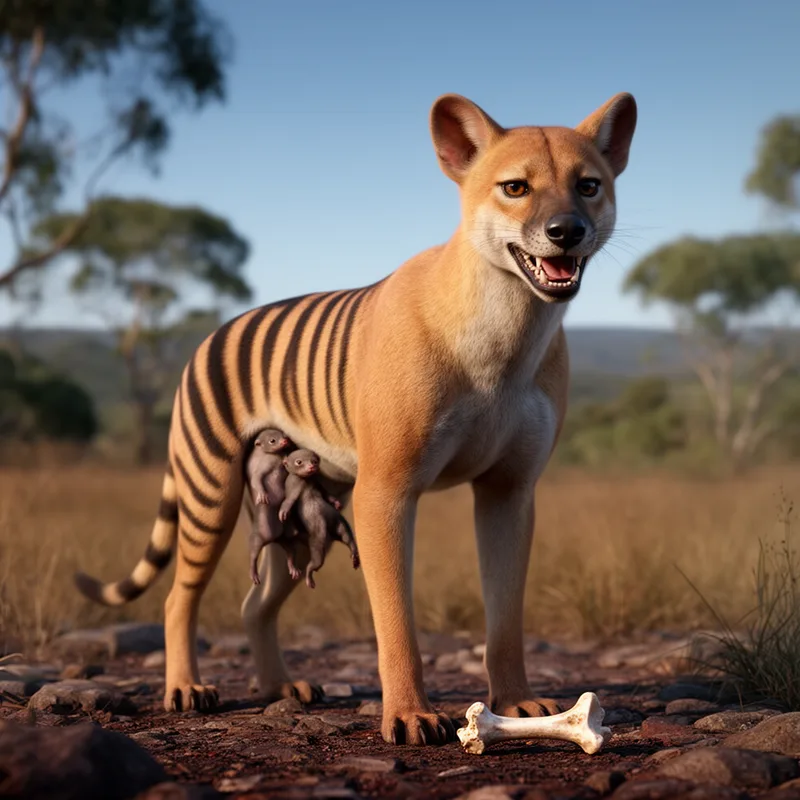
Tasmanian tiger
 1
9.5
1
9.5

- noun
- Australian
- The stripes on the back of the Tasmanian tiger made it easily recognizable before it was declared extinct.
Examples
-
The Tasmanian tiger, also known as the thylacine, is believed to have been the last apex predator of its kind in Tasmania.
-
Ferocious Tasmanian tigers.
-
Many people believe the Tasmanian tiger became extinct due to hunting and habitat loss in the 20th century.
Synonyms


 1
9.9
1
9.9
A doglike animal from Tasmania with stripes on its back called the Tasmanian tiger and thought to be extinct

A probably extinct doglike animal from Tasmania with a pouch and stripes called the Tasmanian tiger

A type of animal from Tasmania that looks like a dog, has stripes on its back, and is now extinct
Surface Forms
Morphology
Tasmanian + tiger
The phrase transparently signals an animal associated with Tasmania and called a 'tiger', so a learner who knows the constituents will infer a striped animal from Tasmania. However, the specific biological facts — that it is a doglike marsupial (not a true tiger) and is thought to be extinct — are not predictable from the parts alone, making the full meaning only partially derivable without prior exposure.
Etymology
Tasmanian tiger: The name Tasmanian tiger comes from the animal's stripes and where it lived. People called the pouch animal a tiger because the dark stripes on its back looked like a tiger's, and Tasmanian tells the island it came from, so today the name means a doglike striped animal from Tasmania thought to be 'extinct'.