
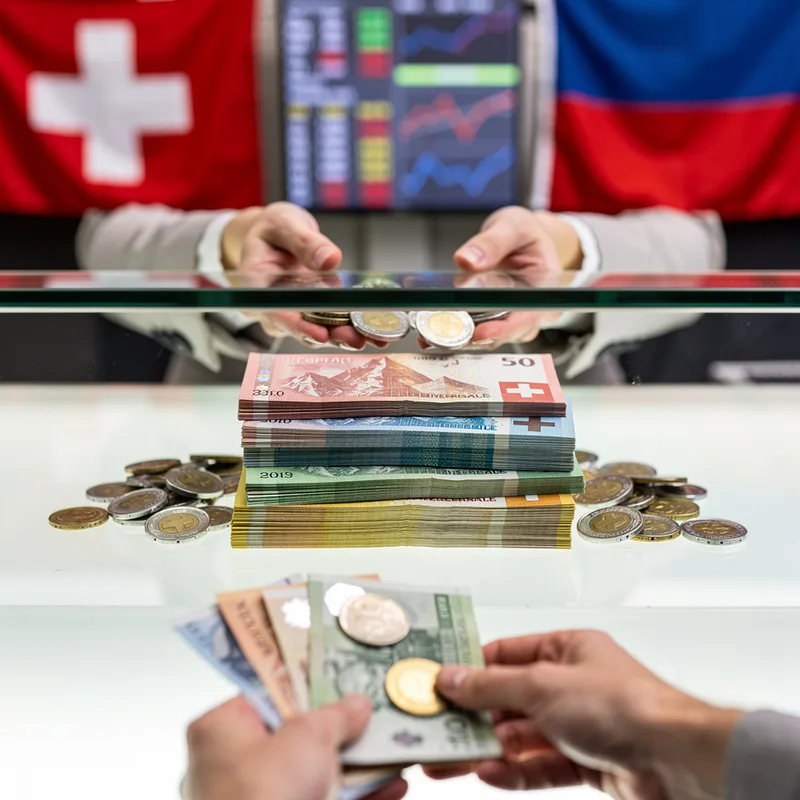
Swiss franc
 3
2.5
3
2.5

- noun
- Tourists planning to visit Switzerland should consider exchanging their money for Swiss francs.
Loading YouTube…
Watch on YouTubeIBM at the time had large amounts of Swiss franc and German Deutsche Mark debt.
- IBM at the time had large amounts of Swiss franc and German Deutsche Mark debt.
- He, he would have to move the market if he was, you know, doing a yard of EUR or Swiss francs or who knows what as like a billion that would move the market.
- I have investments in euros, in British pounds and the Swiss francs, the manager of European portfolio and one of the O Shares ETFs.
Examples
-
Based on the sum-of-the-parts valuations, the target price is set at 23 Swiss francs.
Blog text (32) -
The bank's decision to lay off 10,000 workers would save 3.4 billion Swiss francs.
Blog text (19) -
A 1,000-Swiss-franc note is the equivalent value of ten $100 bills.
-
To date, the company has invested 30 million Swiss francs in the business.
Academic text (2001) -
Second, the Canadian dollar and the Swiss franc do not have enough trading volume.
Blog text (4) -
The swap is based on the strength of the British pound against the Swiss franc.
Blog text (3) -
My share is 400,000 in Swiss francs.
-
A stronger Swiss franc would further increase its trade imbalance with the Eurozone.
Blog text (9) -
The strength of the Swiss franc is undermining the competitiveness of Swiss companies.
Blog text (17) -
Even "relatively" stable currencies like the U.S. dollar, the D-mark, and the Swiss franc have lost two-thirds of their value since 1950.
Academic text (1990)
Surface Forms
Morphology
The noun phrase combines the adjective 'Swiss' (from Switzerland) with 'franc' (a currency unit), so the meaning — the currency unit used in Switzerland/Liechtenstein — is directly derivable from its parts. This straightforward adjectival-noun composition is common cross-linguistically and follows regular compounding patterns, so a B1 learner who knows both constituents will understand it.
Etymology
Swiss franc got its name when Switzerland created one national money in the 1800s; they used the word franc from the common French coin and added Swiss to show it belonged to Switzerland, so today it means the country's official 'currency'.