
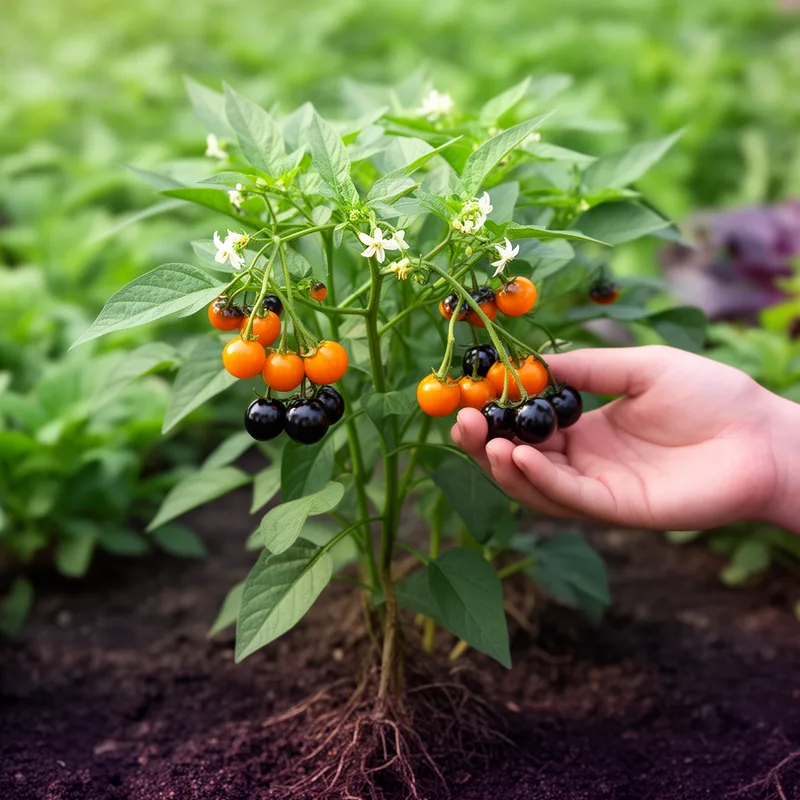
Solanum nigrum guineese
- noun
- Specialized
 :
solanácea guineana
:
solanácea guineana
- The Solanum nigrum guineese in the vegetable garden produced abundant orange berries this summer.
Examples
-
Researchers are studying Solanum nigrum guineese as a potential crop for improving food security in West Africa.
-
Many communities use Solanum nigrum guineese for its edible fruit and nutritional leaves.
-
The Solanum nigrum guineese is known for its vibrant orange berries.
-
Have you ever tried Solanum nigrum guineese?
-
Many gardeners cultivate Solanum nigrum guineese for its small, edible orange berries.
-
In various recipes, Solanum nigrum guineese is praised for adding unique flavor and nutrition.
-
Farmers in West Africa are increasingly planting Solanum nigrum guineese due to its edible fruit and leaves.
Synonyms


 1
9.9
1
9.9
A garden plant people grow for its small orange or black edible berries

A garden plant grown for its small edible orange or black berries

A garden plant with small edible orange or black berries
A small edible berry from a garden plant that turns orange or black when ripe

A small garden plant people grow for edible dark or orange berries
Surface Forms
Morphology
Solanum + nigrum + guineese
This is a Latin botanical name: 'Solanum' clearly signals a plant genus and the elements 'nigrum' (Latin for 'black') and 'guineese' (suggesting a Guinea/Guinean origin) give partial clues about colour and provenance. However, Latinized taxonomic terms and the specific cultivar meaning (a garden variety with small edible orange or black berries) are not fully predictable for an average B1 learner, so the relation is only partially transparent.
Etymology
Solanum nigrum guineese joins Solanum nigrum, the 'black nightshade', with guineese, a word that links the plant to Guinea in West Africa. So the name gives a simple picture: a garden variety of black nightshade from that region, known for its edible berries and leaves.