
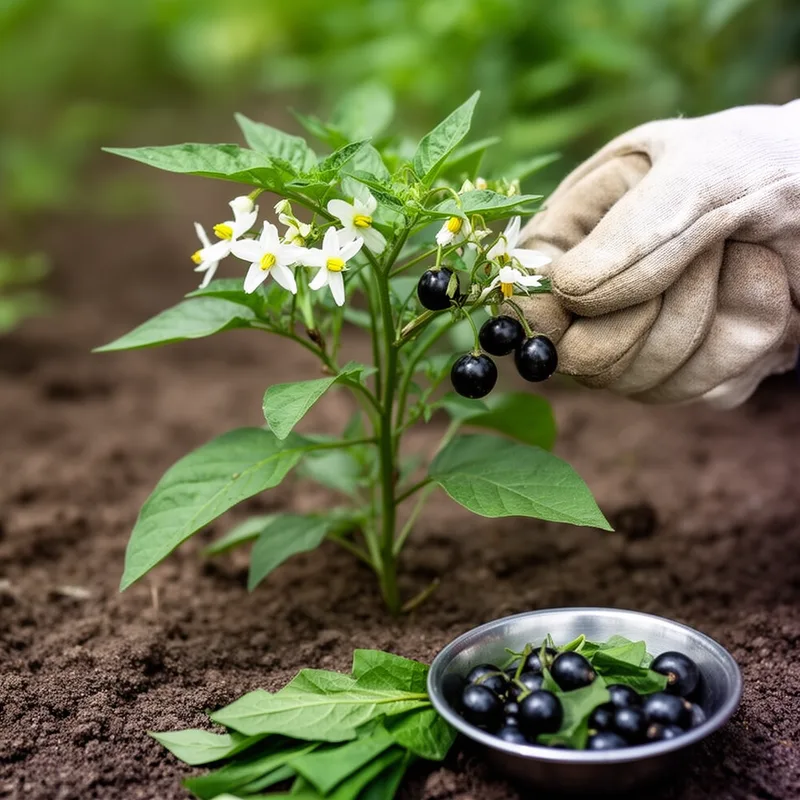
Solanum nigrum
- noun
- Specialized
 :
solanácea negra
:
solanácea negra
- The berries of Solanum nigrum may be toxic if consumed without proper identification.
Examples
-
Certain edible varieties of Solanum nigrum are used in traditional dishes after careful preparation.
-
Solanum nigrum can be found growing in fields and gardens across Europe and Asia.
-
The Solanum nigrum plant is often found in gardens.
-
Many people are unaware that Solanum nigrum can be toxic.
-
Certain edible varieties of Solanum nigrum are used in traditional dishes after careful preparation.
-
The berries of Solanum nigrum may be toxic if consumed without proper identification.
-
Solanum nigrum can be found growing in fields and gardens across Europe and Asia.
Synonyms

A plant with white flowers and black berries whose parts can be poisonous
A plant from Europe and Asia with white flowers and black berries that can be poisonous

A small plant with black berries and hairy leaves that can make people sick
Surface Forms
Morphology
Solanum + nigrum
The name is a compositional Latin binomial: 'Solanum' identifies the genus and 'nigrum' (Latin for 'black') yields the sense 'black Solanum', so a learner who knows both constituents and taxonomic naming could infer it denotes a black species in the Solanum genus. However, without botanical knowledge the common name 'black nightshade' and the plant's edible/poisonous properties are not fully predictable from the parts, so the meaning is only partially transparent.
Etymology
Solanum nigrum comes from Latin: Solanum is the name for the nightshade group and nigrum means 'black', which gives a clear picture of the plant's dark berries. So the name helps you remember this herb with white flowers and black berries that can be poisonous or, in some varieties, eaten after careful preparation.

