

Silybum marianum
- noun
- Specialized
- Many herbal supplements contain extracts of Silybum marianum, more commonly known as milk thistle.
Examples
-
The fields were dotted with the striking purple flowers of Silybum marianum.
-
Researchers are studying the medicinal properties of Silybum marianum in the treatment of liver disorders.
-
The Silybum marianum plant is often used in herbal medicine.
-
Many people are unfamiliar with Silybum marianum.
-
Some people use Silybum marianum as a natural remedy to improve liver health.
-
You can find Silybum marianum supplements in many health food stores.
-
Many traditional herbalists recommend Silybum marianum for its potential health benefits.
Synonyms

 1
5.0
1
5.0

A tall prickly plant with purple flowers and white spots on leaves used in herbal medicine to help the liver


 1
9.9
1
9.9
A tall plant with spiky leaves, white marks, and purple flower heads used in herbal medicine
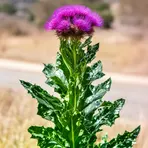
A tall plant with large green leaves with white patches and purple flowers

A tall prickly plant with purple flowers and large leaves with white veins
Surface Forms
Morphology
Silybum + marianum
This is a Latin binomial (scientific) name rather than an ordinary English compound, so its meaning ('milk thistle') is not compositionally derivable from the parts; 'marianum' is a Latin epithet that B1 learners will not recognise. Botanical Latin functions like a proper name referring to a specific species, so even learners who know the supplied glosses would not reliably infer the common-name meaning.
Etymology
Silybum marianum is the Latin name for the plant often called milk thistle. The leaves have white patches that look like milk drops, and one old story says the Virgin Mary spilled milk on the leaves, so the Latin name 'marianum' links the plant to Mary and the common name reminds us of 'milk'.