
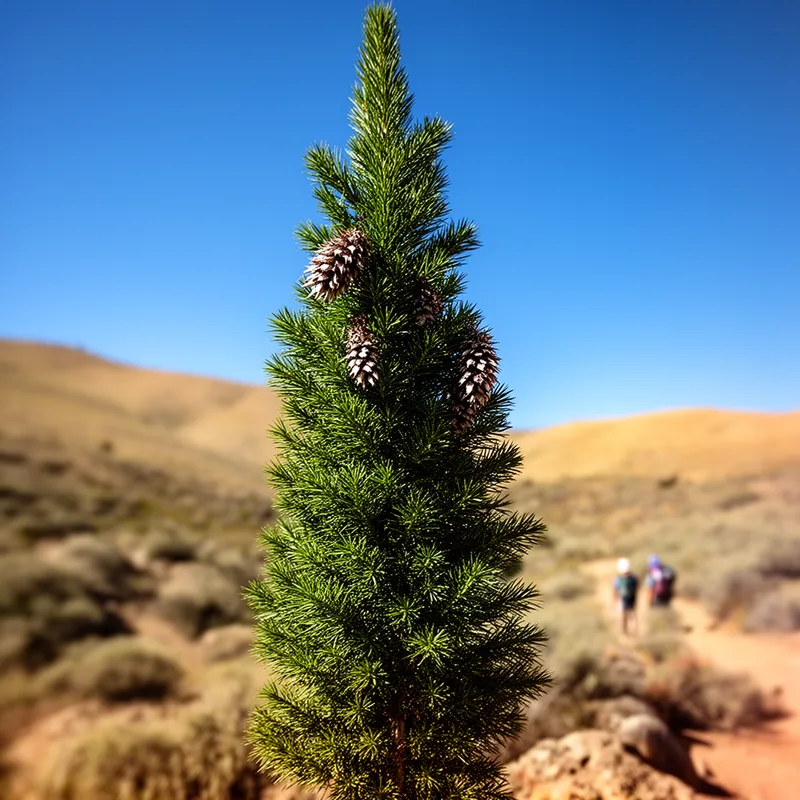
Santa Lucia fir
- noun
- Specialized
- Hikers admired the distinctive spiny cones of the Santa Lucia fir along the trail.
Examples
-
Efforts are underway to preserve the endangered Santa Lucia fir in its natural habitat.
-
The Santa Lucia fir is considered one of the rarest firs in the world.
-
The Santa Lucia fir is known for its distinctive shape.
-
Many Santa Lucia firs grow in the coastal mountains.
-
Hikers admired the distinctive spiny cones of the Santa Lucia fir along the trail.
-
Efforts are underway to preserve the endangered Santa Lucia fir in its natural habitat.
-
The Santa Lucia fir is considered one of the rarest firs in the world.
Synonyms

A tall evergreen tree from southwestern California with sharp needle-like leaves and cones that have long spines

A cone-shaped fir tree from southwestern California with sharp leaves and spiny cones

A tall fir tree with spiny pointed leaves and cones found only in a small area of California
Surface Forms
Morphology
Santa + Lucia + fir
The head noun 'fir' clearly denotes a type of needle-leaved tree, and the preceding proper name 'Santa Lucia' functions as a place-based modifier indicating origin or variety; this composition (place-name + species) makes the overall meaning 'a fir from Santa Lucia' directly inferable. Such place-based species names are cross-linguistically common, so a B1 learner who knows the constituents would understand this refers to a specific kind of fir tree.
Etymology
Santa Lucia fir gets its name from the Santa Lucia Mountains in California, where this type of fir tree grows. Because it lives mostly in that mountain area and has sharp, pointy leaves and spiny cones, the name now refers to this rare local 'fir' species.

