

Sanguinaria canadensis
- noun
- /sæŋɡwɪˈnɛəriə kænəˈdɛnsɪs/
- Specialized
- In the spring, patches of Sanguinaria canadensis can be seen blooming on the forest floor.
Examples
-
The white petals of Sanguinaria canadensis appear briefly before the trees fully leaf out.
-
Traditional medicines often made use of Sanguinaria canadensis for its expectorant properties.
-
The Sanguinaria canadensis blooms in early spring.
-
Many gardeners appreciate Sanguinaria canadensis for its beauty.
-
In the spring, patches of Sanguinaria canadensis can be seen blooming on the forest floor.
-
The white petals of Sanguinaria canadensis appear briefly before the trees fully leaf out.
-
Traditional medicines often made use of Sanguinaria canadensis for its expectorant properties.
Synonyms

 1
9.9
1
9.9

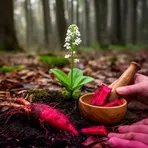
A North American plant that has red root sap, a single white spring flower, and is used in traditional medicine

 1
9.9
1
9.9
A forest plant with a red root and small white flower used as medicine

A woodland plant with a red root and a single white early-spring flower used in traditional remedies
Surface Forms
Morphology
The name is compositionally built from a genus name ('Sanguinaria' — a group of flowering plants) plus a species epithet ('canadensis' — indicating origin from Canada), so its referent (a plant species from that genus native to Canada) is directly inferable from the parts. Taxonomic binomials follow a regular, cross-linguistic pattern (genus + origin/descriptor), making the meaning predictable to learners who know both constituents.
Etymology
Sanguinaria canadensis gets its name from Latin words: sanguinaria comes from the word 'blood' because the plant's root and sap are red, and canadensis means 'from Canada' or 'from North America'. So the name gives the image of a red-rooted woodland flower from that region.