
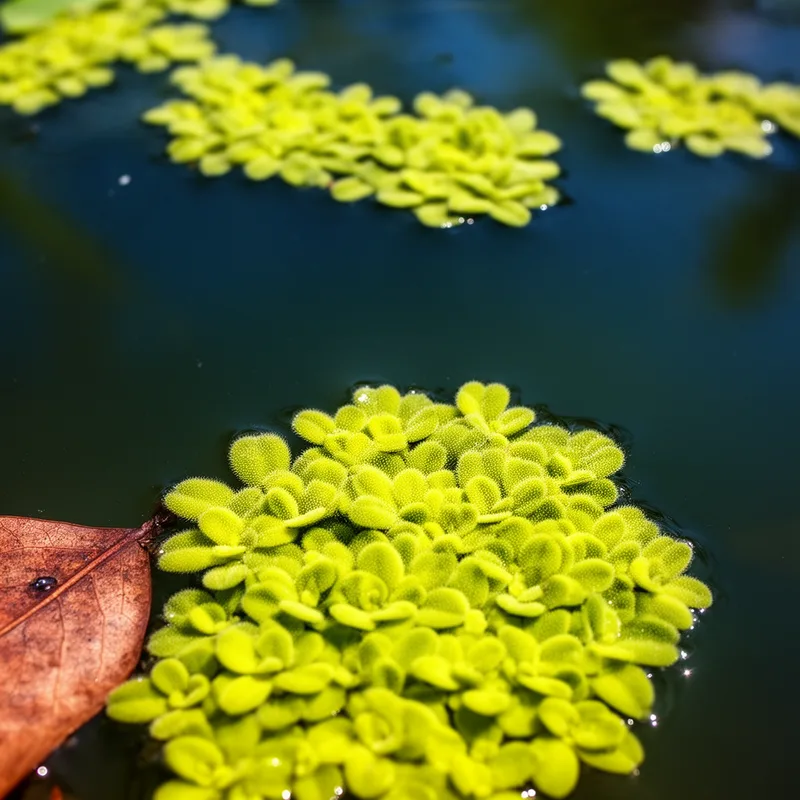
Salvinia


 1
9.6
- noun
- /sælˈvɪniə/
- Specialized
- Giant salvinia is known for its rapid growth and ability to cover large areas of freshwater bodies.
- giant Salvinia
- Salvinia infestations
- healthy Salvinia
Examples
-
To perform tests of water quality, entomologist Philip Tipping collects water samples from a tank infested with giant and common salvinia.
Academic text (2001) -
At other sites, growth was so dense that some of the salvinia, starved of nitrogen and other nutrients, turned brown.
Academic text (2001) -
In some places, giant salvinia was a healthy green.
Academic text (2001) -
Common salvinia is an earlier invader that is now part of the landscape, according to Ted D. Center.
Academic text (2001) -
Giant salvinia, or Salvinia molesta, is a bother to humans as well.
Academic text (2001) -
Everitt found that if the salvinia plants were healthy, their green light reflectance could be easily distinguished from that of other plants.
Academic text (2001) -
ARS researchers were the first in the United States to use a beneficial insect to attack salvinia.
Academic text (2001) -
Everitt began his salvinia research by measuring the light reflectance of giant salvinia and other nearby aquatic plants.
Academic text (2001) -
Areas with healthy green salvinia foliage (arrow 1) are easily distinguished from those with dying foliage (arrow 2).
Academic text (2001) -
Giant salvinia is among the invasive species profiled in a comprehensive database maintained by the ARS National Agricultural Library.
Academic text (2001)
Compounds
- Specialized
A floating water fern from tropical Americas that forms dense mats on ponds
- Specialized
A floating fern with round leaves that forms dense mats in calm freshwater
Surface Forms
Etymology
Salvinia is the name for a group of 'water ferns' and was named after the English naturalist Osbert Salvin. So, think of the scientist Salvin when you see Salvinia, a fast-growing floating fern that can quickly cover a pond.