
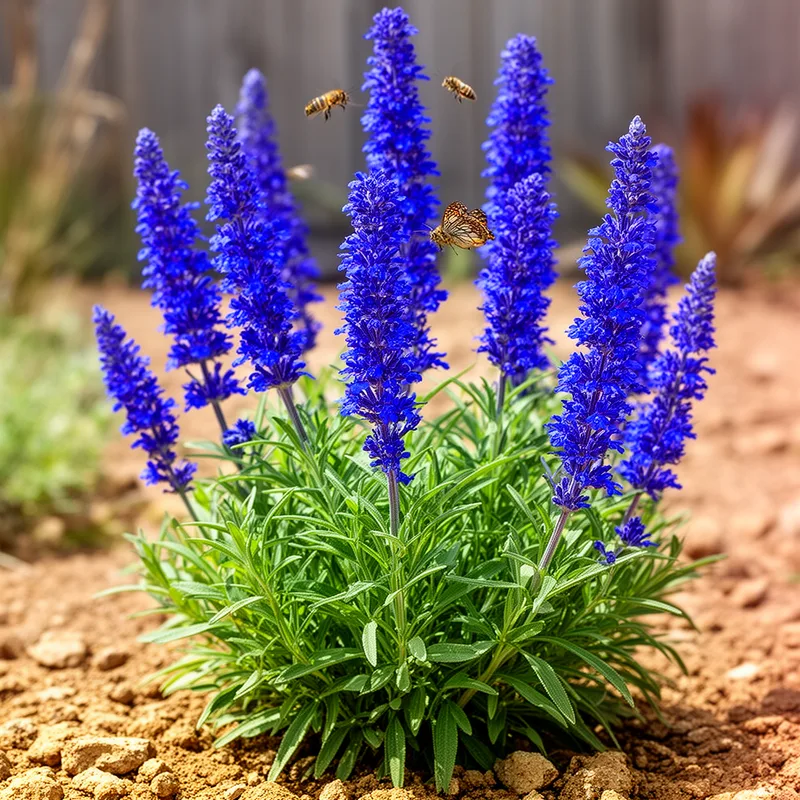
Salvia farinacea
- noun
- Specialized
- The garden center recommended planting Salvia farinacea for a splash of vibrant blue color in summer.
Examples
-
Unlike many sages, Salvia farinacea can thrive in hot, dry Texas climates.
-
Bees and butterflies are often attracted to the blossoms of Salvia farinacea.
-
I planted Salvia farinacea in my garden this spring.
-
Have you seen the beautiful Salvia farinacea blooming?
-
The garden center recommended planting Salvia farinacea for its intensely blue flowers.
-
Bees and butterflies are often attracted to the blossoms of Salvia farinacea.
-
Unlike many sages, Salvia farinacea flourishes in the hot, dry Texas climate.
Synonyms

A small plant with spikes of bright blue flowers and gray-green leaves

A plant with blue flowers that smells pleasant and grows in North America
Surface Forms
Morphology
salvia + farinacea
The form is a Linnaean binomial: 'Salvia' clearly identifies the genus (a sage), so a learner who knows the constituents can infer it names a kind of sage. However the specific epithet 'farinacea' is a Latin descriptor (literally 'mealy'/'floury') and does not convey the full species-specific information (native range, intense blue flowers) to a typical B1 learner, so the meaning is only partially predictable from the parts.
Etymology
Salvia farinacea comes from old Latin words: Salvia meaning 'sage' and farinacea meaning 'powdery' or 'mealy'. Think of a 'powdery sage' with dusty leaves and bright blue flowers from Texas, so the name describes this species and helps you remember it.

