

blue sage
- noun
- /blu seɪdʒ/
- US
- Walking through the desert, we discovered patches of blue sage, whose distinct fragrance filled the air.
Examples
-
In the late summer, blue sage blooms beautifully, adding a splash of violet-blue to the landscape.
-
The garden was filled with the vibrant colors of blue sage, its aromatic flowers attracting many bees.
-
Scrub pine, mesquite, pale blue sage, and tumbleweeds all around us; we see our freedom everywhere we look, for everywhere we look, we see ourselves.
Fiction book (1997)
Synonyms

A plant with bright blue flowers that grows on dry prairies in eastern United States
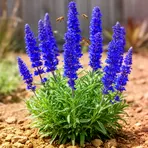
A sage plant from Texas and nearby Mexico with bright blue flowers

A small plant with spikes of bright blue flowers and gray-green leaves

A sage plant with violet-blue flowers often grown in gardens

A plant from North and Central America with purple-blue flowers often grown in gardens

A small sage plant with curved leaves like a harp and pale blue flowers that grows in eastern US woodlands

A tall California plant that lives many years with fragrant leaves and pale blue or violet flowers
Surface Forms
Morphology
The meaning is a straightforward adjective+noun composition: 'blue' (a color) modifying 'sage' (the herb), so it denotes a sage plant with blue flowers or coloring. This literal, descriptive pattern is regular in English (and common across languages), so a B1 learner who knows both constituents will readily infer the meaning.
Etymology
Blue sage gets its name from how it looks and smells: the word blue for its blue flowers and sage because the leaves smell like the cooking herb. So today blue sage means 'a scented plant with blue flowers'.

