

Salvadora persica
- noun
- Specialized
- In many Middle Eastern countries, twigs of Salvadora persica are used as natural toothbrushes.
Examples
-
The desert nomads fed Salvadora persica shoots to their camels during long journeys.
-
Researchers studied the medicinal properties of Salvadora persica extracts for oral health.
-
The Salvadora persica is often used as a natural toothbrush.
-
Many people prefer Salvadora persica over synthetic toothbrushes.
-
In many Middle Eastern countries, twigs of Salvadora persica are used as natural toothbrushes.
-
The desert nomads fed Salvadora persica shoots to their camels during long journeys.
-
Researchers studied the medicinal properties of Salvadora persica extracts for oral health.
Synonyms

A small evergreen tree from dry regions whose branches are used as natural toothbrushes and whose shoots are animal food
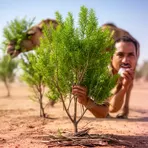
A small evergreen tree whose twigs people use to clean their teeth
Surface Forms
Morphology
Salvadora + persica
This is a Latin scientific name (genus + species epithet) rather than a compositional English phrase, so a B1 learner who knows the surface constituents would not be able to infer the specific meaning or its uses (e.g. twigs used as toothbrushes). The specific epithet 'persica' is not a common English word and taxonomic names follow conventions unfamiliar to most learners, making the overall meaning unpredictable from the parts.
Etymology
Salvadora persica is often called the 'toothbrush tree' because people chew its twigs and use them like small brushes called 'miswak' to clean their teeth. That's why the name brings to mind natural oral care and the plant's use as food, since people also fed its shoots to camels on long journeys.

