
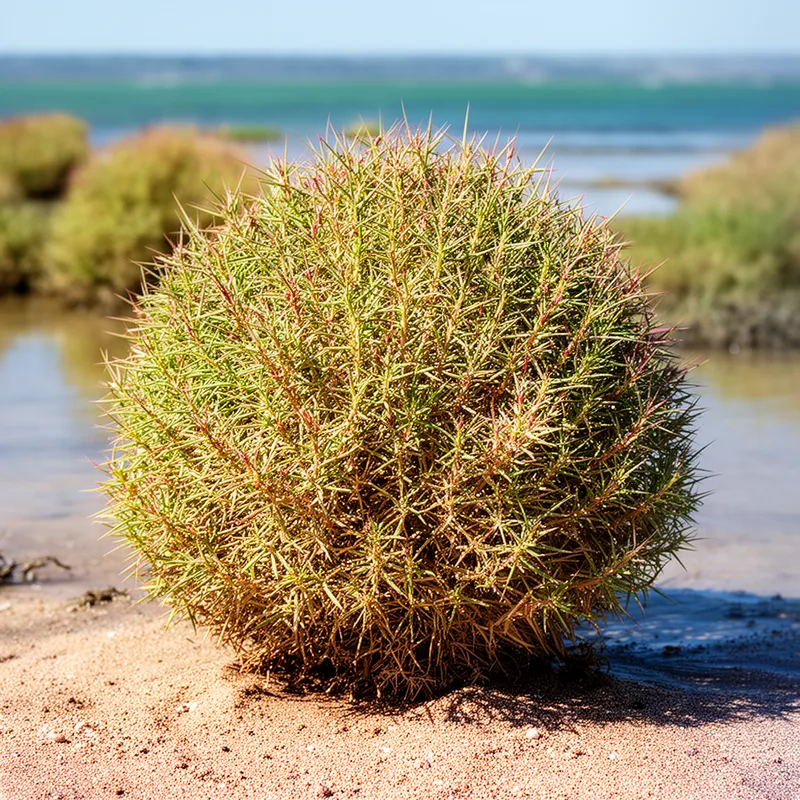
Salsola kali
- noun
- Specialized
- Glassmakers once burned Salsola kali to extract soda ash for their craft.
Examples
-
In coastal regions, Salsola kali often forms dense thickets along the sandy shorelines.
-
The prickly leaves of Salsola kali can make it difficult to walk barefoot through salt marshes.
-
The Salsola kali thrives in salty environments.
-
Many coastal regions have abundant Salsola kali growth.
-
Historically, Salsola kali was burned to produce soda ash, a key ingredient for glassmaking.
-
In coastal salt marshes, Salsola kali grows in dense clusters, providing habitat for various wildlife.
-
With its prickly leaves, Salsola kali can pose a challenge for people walking in sandy beach areas.
Synonyms


 1
9.9
1
9.9
A plant that people burn to make soda ash for glass and soap

A bushy plant that grows on salt marshes and beaches with prickly leaves used to make soda ash

A bushy coastal plant with prickly leaves that grows in salt marshes and on beaches

A plant that grows in wet areas near the sea with thick stems used to make ashes for glass

A plant that grows in salty coastal marshes
Surface Forms
Morphology
This is a Latin taxonomic binomial formed by genus (Salsola) + species epithet (kali); the combination directly denotes the specific plant described, so a learner who knows the constituent meanings can infer it refers to that bushy, salt-marsh plant. Binomial nomenclature is used across languages, making the compositional logic predictable rather than idiomatic.
Etymology
Salsola kali gets its name from two old words: Salsola, linked to 'salt' because the plant grows in salty places, and kali, linked to the 'soda ash' people made by burning the plant for use in glassmaking. That's why the name reminds us both of its coastal home and its old useful ashes.