

Salmonella enterica
- noun
- /ˌsælməˈnɛlə ˈɛntərɪkə/
- Specialized
 :
Salmonella enterica
:
Salmonella enterica
- Researchers are studying Salmonella enterica to understand how it causes illnesses in humans.
- Salmonella enterica serovar
- Salmonella enterica serovar Typhimurium
Examples
-
Salmonella enterica was recovered from nine (20 percent) of the samples during the first period and nine (9 percent) during the second period.
Academic text (2002) -
Salmonella enterica (n 21) of different serovars, detected in 18%, was the next commonest pathogen.
Academic text (1992) -
Eight laboratory-confirmed cases of infection with Salmonella enterica serotype Typhimurium of the same genetic subtype were identified through routine surveillance.
Academic text (2012) -
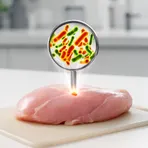
If not cooked properly, Salmonella enterica can contaminate chicken and cause food poisoning.
-
An outbreak of Salmonella enterica resulted in several hospitalizations due to contaminated food.
Synonyms
 22
5.5
22
5.5

A type of germ that can cause food poisoning and other serious illnesses
Surface Forms
Morphology
salmonella + enterica
This is a taxonomic binomial composed of the genus name 'Salmonella' plus a specific epithet; a learner who knows the constituents can directly infer it denotes a particular species of Salmonella. The term is compositional and non‑idiomatic (genus + species naming is cross‑linguistically regular), so its basic meaning as a type of Salmonella is transparent to learners.
Etymology
The name Salmonella enterica comes from a person and a word for the gut: Salmonella is named after Dr Salmon and enterica comes from a word meaning 'intestine'. So the name gives the image of 'Salmon's bacteria in the intestine', which fits because these bacteria live in animals' guts and often cause 'food poisoning'.