
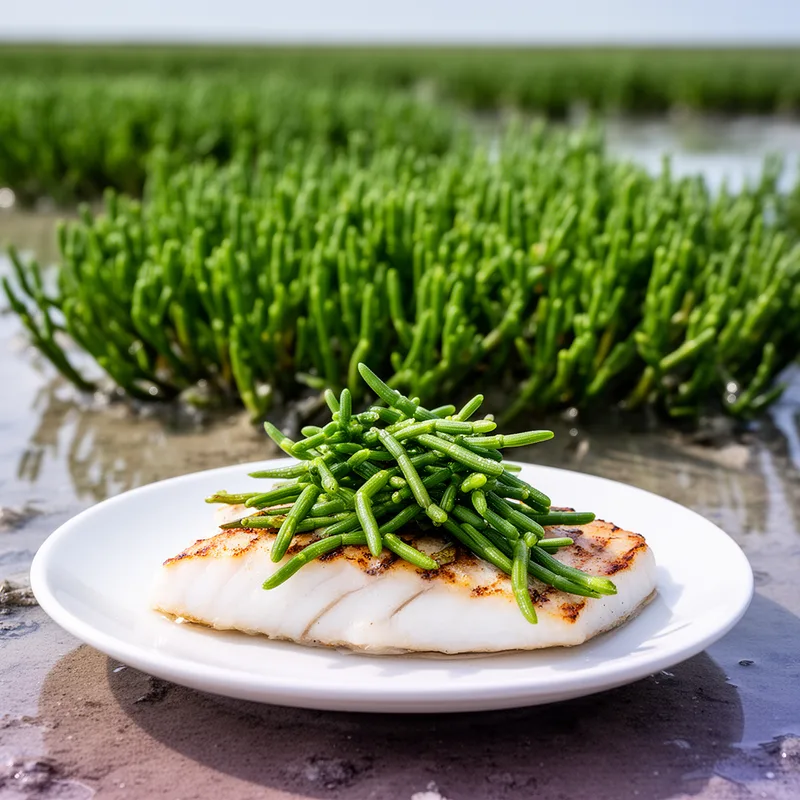
Salicornia europaea
- noun
- Specialized
- In the salt marsh, Salicornia europaea forms dense green carpets in late summer.
Examples
-
Historically, people burned Salicornia europaea to obtain soda ash for glassmaking.
-
Many chefs now use Salicornia europaea as a delicate, salty garnish for seafood dishes.
-
I found Salicornia europaea growing near the beach.
-
Have you ever tried Salicornia europaea in a salad?
-
Historically, people burned Salicornia europaea to obtain soda ash for glassmaking.
-
In the salt marsh, Salicornia europaea forms dense green carpets in late summer.
-
Many chefs now use Salicornia europaea as a delicate, salty garnish for seafood dishes.
Synonyms


 1
9.9
1
9.9
A thick plant that stores water and grows in salty marshes by the sea
A thick-stemmed coastal plant with small flat leaves that grows in salt marshes

A plant that grows in wet areas near the sea with thick stems used to make ashes for glass
Surface Forms
Morphology
Salicornia + europaea
This is a Linnaean binomial composed of the genus name 'Salicornia' (a salt‑marsh plant) and the Latin epithet 'europaea' (of Europe). A learner who knows both constituents would transparently infer it denotes the European species of Salicornia — a fleshy coastal plant — because taxonomic Latin names are compositional and cross‑linguistically predictable in this way.
Etymology
Salicornia europaea is a soft, salty plant that grows in salt marshes. People once burned Salicornia europaea to make 'soda ash' for glass, which gave it the old name 'glasswort', and its salty, crunchy stems are why chefs now use it as a garnish.