

Saccharum bengalense
- noun
- Specialized
- Ropes made from Saccharum bengalense are known for their strength and durability.
Examples
-
The villagers use Saccharum bengalense to weave sturdy baskets for everyday use.
-
Researchers are studying Saccharum bengalense for its potential in sustainable crafts and biofiber production.
-
The plant Saccharum bengalense is commonly found in India.
-
Farmers use Saccharum bengalense for making ropes.
-
The villagers use Saccharum bengalense to weave sturdy baskets for everyday use.
-
Ropes made from Saccharum bengalense are known for their strength and durability.
-
Farmers use Saccharum bengalense to make strong ropes for agricultural purposes.
Synonyms


 1
9.9
1
9.9
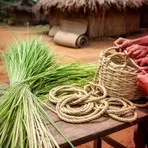
A strong Asian grass people use for making rope and baskets

A tough grass from Asia with stems people use to make ropes and baskets
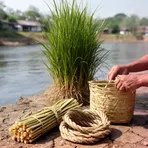
A tough Asian grass whose stems people use to make ropes and baskets
Surface Forms
Morphology
Saccharum + bengalense
This is a Latin binomial made of the genus Saccharum (perennial grasses) plus the species epithet bengalense, so in principle it means ‘a Saccharum species from Bengal’ and has compositional logic. However, B1 learners typically do not know Latin taxonomic conventions or the suffix -ense, and the second element is not a familiar English word, so the meaning is not directly derivable for most learners without specific knowledge.
Etymology
Saccharum bengalense is a tall, tough grass whose long, strong stems were often twisted into 'ropes' or woven into 'baskets', so imagine people braiding long stalks to make useful, hard-wearing items. That's why the plant is known for its strong, useful fiber, and the second word bengalense points to its origin near Bengal.