
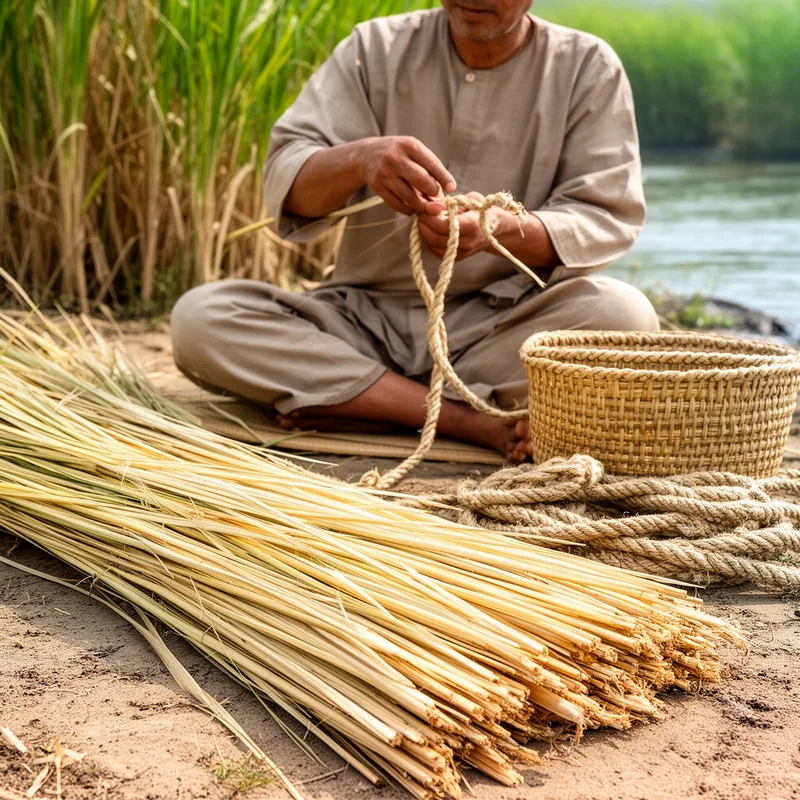
Saccharum munja
- noun
- Specialized
- Ropes made from Saccharum munja are valued for their strength and durability.
Examples
-
The villagers use Saccharum munja to weave sturdy baskets and mats.
-
Farmers in India often cultivate Saccharum munja for its strong fibers.
-
In some parts of India, Saccharum munja grows abundantly near riverbanks.
-
The plant Saccharum munja grows well in tropical climates.
-
In some parts of India, Saccharum munja grows abundantly near riverbanks.
-
Ropes made from Saccharum munja are valued for their strength and durability.
-
The villagers use Saccharum munja to weave sturdy baskets and mats.
Synonyms


 1
9.9
1
9.9
A strong Asian grass people use for making rope and baskets
A tough Asian grass whose stems people use to make ropes and baskets
A tall strong grass whose stems people use to make ropes and baskets
Surface Forms
Morphology
This is a straightforward botanical binomial combining the genus 'Saccharum' (perennial grasses) with the specific epithet 'munja' (a grass used for making ropes and baskets). A B1 learner who knows both constituents can directly infer it denotes a particular grass species with those properties and uses, so the meaning is compositional and transparent.
Etymology
Saccharum munja may come from the scientific word Saccharum (linked to 'sugar') and the local word munja or 'munj' for a tough grass. The name fits the plant because its strong stems are used to make ropes and baskets, so it reminds us that this is a hard, useful grass.