

Saccharomyces cerevisiae


 1
4.6
1
4.6
- noun
- /sæˈkɛrəˌmɪsiːz ˌsɛrəˈvɪsiˌeɪ/
- Specialized
- In brewing, Saccharomyces cerevisiae is essential for producing flavorful ales and lagers.
- yeast Saccharomyces cerevisiae
Examples
-
The heifers of the supplemented group received yeast culture (Saccharomyces cerevisiae, Yea-Sac1026).
Academic text (2015) -
The effects of Saccharomyces cerevisiae on growth performance, blood parameters, nutrient digestibility, fecal coliform, and Lactobacillus were studied.
Academic text (2015) -
Keywords: Sahiwal heifers; Saccharomyces cerevisiae; Growth rate; Digestibility; Coliform; Lactobacillus.
Academic text (2015) -
The heifers in the supplemented group were fed with Saccharomyces cerevisiae (Alltech Inc., Nicholasville, KY), 5 g/animal/day.
Academic text (2015) -
Many bakers rely on Saccharomyces cerevisiae for making bread rise and create a light texture.
-
During fermentation, Saccharomyces cerevisiae transforms sugars into carbon dioxide and alcohol.
Synonyms
 68
1.1
68
1.1
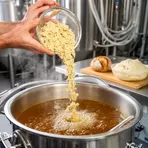
A very small living thing used in baking and brewing to make dough rise or ferment drinks
 1
3.4
1
3.4
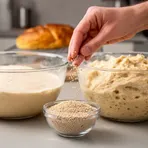
A type of yeast used to make beer and sometimes bread
 1
2.9
1
2.9
A small living thing used in baking to make dough rise
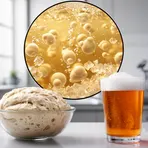
A yeast made of one cell that turns sugar into gas and alcohol in bread and beer
Surface Forms
Morphology
Saccharomyces + cerevisiae
This is a scientific Latin binomial (genus + species) rather than a compositional everyday phrase; its meaning (a particular species of yeast used for brewing/baking) depends on domain knowledge and knowledge of Latinized epithets. Even if a learner knows 'Saccharomyces' as yeast, the species epithet 'cerevisiae' is not a transparent English word for a B1 learner, so the overall meaning is not derivable from the parts.
Etymology
Saccharomyces cerevisiae comes from old word parts: saccharo means 'sugar', myces means 'fungus', and cerevisiae means 'of beer'. So the name is like calling it a 'sugar fungus of beer' and explains that this yeast eats sugar to make bread rise and to make alcohol.