
SCNT
- noun
- Specialized
- The debate over human cloning again grabbed headlines when, in 2004, South Korean researcher Woo Suk Hwang claimed that he had created the first stem cell line derived from a human embryo created through SCNT.
- SCNT embryo
- SCNT-embryonic stem cell
- human SCNT
Examples
-
Just over a year later, Hwang reported that he had followed this success with another: the creation of 11 patient-specific stem cell lines derived from SCNT embryos using the patient's somatic cells.
Academic text (2017) -
Indeed, only a small number of research teams have reported successfully deriving stem cell lines from SCNT-created embryos at all, indicating that more and more basic research is required to develop this technology.
Academic text (2017) -
After all, human cloning by SCNT requires both a human somatic cell and a human egg into which the somatic cell can be transferred.
Academic text (2017) -
To date, the efficiencies of both SCNT embryo creation and stem cell derivation are far from 100%.
Academic text (2017) -
The state of the art in SCNT is still developing, and so the use of SCNT for human reproduction would "pose the risk of... possibly severe developmental abnormalities in any resulting child."
Academic text (2017) -
The cell lines Hwang reported creating would have been the first successfully derived-from-human SCNT embryos, and those lines would have been created on a much more efficient scale than previously reported SCNT attempts.
Academic text (2017) -
In 1996, researchers produced a sheep, Dolly, using somatic cell nuclear transfer ("SCNT"), commonly known as "cloning."
Academic text (2017) -
As described above, given the current inefficiencies in both SCNT and stem cell derivation technologies, the number of human eggs that would be required to support basic and other scientific research on human cloning is staggering.
Academic text (2017) -
Researchers envision a multi-step process in which they use a patient's somatic cell to generate a SCNT embryo, from which they can subsequently derive an embryonic stem cell line.
Academic text (2017) -
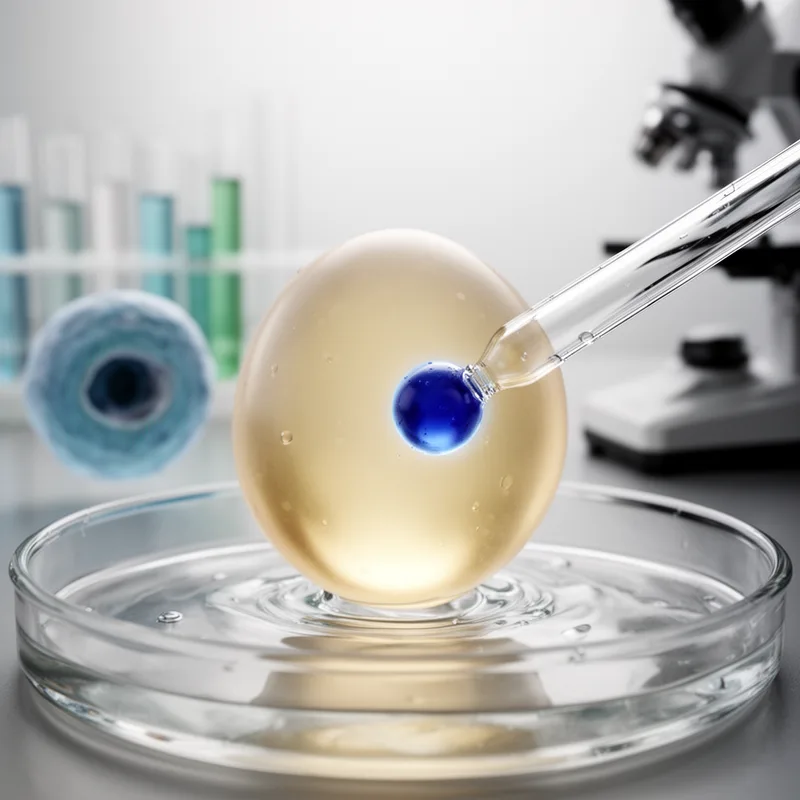
In the process of SCNT, scientists transfer the nucleus from a somatic cell into an egg cell that has had its nucleus removed.
Synonyms

A lab method for making clones by moving a body cell's center into an egg cell without one
A method of putting the nucleus from a body cell into an egg cell whose nucleus has been removed

To move a cell's nucleus and DNA into another cell for cloning or research
Surface Forms
Morphology
SCNT = S + C + N + T
SCNT is an initialism/acronym; the individual letters do not convey the phrase's meaning to an average learner unless they know the expanded form.
Etymology
SCNT stands for somatic cell nuclear transfer, where somatic means 'of the body', cell is a small living unit, nuclear comes from nucleus meaning 'center', and transfer means 'to move'. So, SCNT is a name that tells you the process: moving the 'center' of a body cell into an egg cell to make a genetic copy, which is why it is used in cloning research.

