
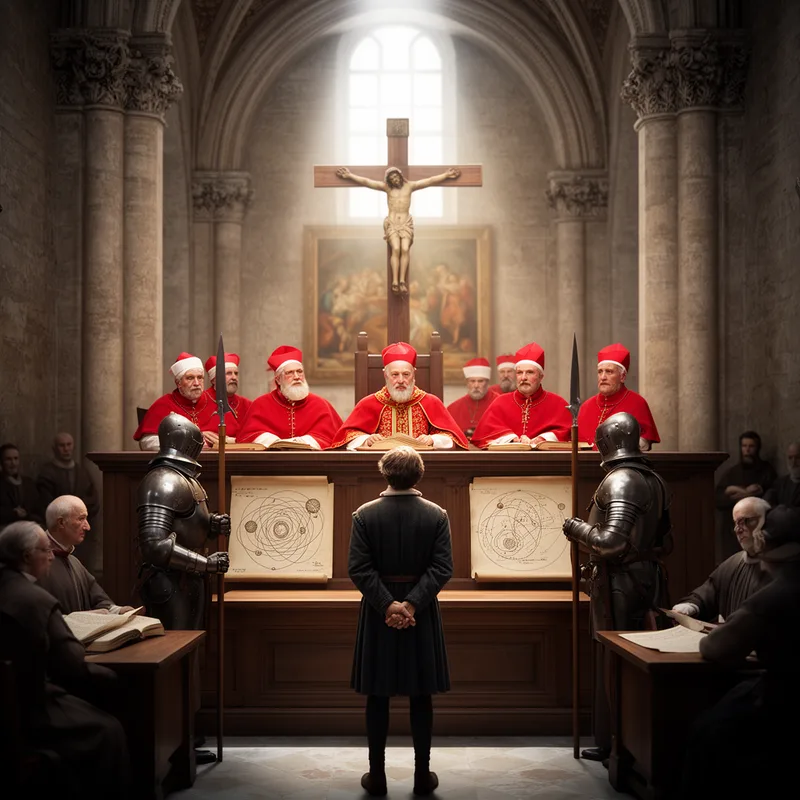
Roman Inquisition


 1
8.7
1
8.7
- noun
- /ˈroʊmən ˌɪnkwɪˈzɪʃən/
- Galileo's trial is one of the most famous cases linked to the Roman Inquisition's efforts to suppress dissent.
Examples
-
Leland's witches fit comfortably with the European stereotype of the female witch that had survived since the time of the Roman Inquisition in the latter half of the 16th century.
Blog text (12) -
Also in 1696, the Faculty censured the works of Maria d'Agreda, which had been condemned by the Roman Inquisition in 1681, a not very subtle way to deny the universal value of that earlier decision.
Academic text (1992) -
And lest anyone suppose that this was merely a parochial fight between one scientist and the Roman Inquisition, it is well to remember that Galileo was generally viewed quite negatively by nearly all Christian thinkers of the time, Protestant and Catholic.
Academic text (1991) -
The Roman Inquisition was established in 1542 to enforce religious orthodoxy in Italy.
-
Many people feared the consequences of speaking out against the teachings of the Roman Inquisition.
Synonyms
 42
9.1
42
9.1
A church court that looks into and punishes people for their religious beliefs
A Roman Catholic church group that judged people for wrong religious beliefs in Italy from 1542
Surface Forms
Morphology
The meaning is directly compositional: 'Inquisition' denotes a tribunal for suppressing heresy and 'Roman' specifies the Roman (Catholic) affiliation, so a learner who knows both words will infer it is the Inquisition associated with the Roman Catholic Church. Historical specifics (date, role in Galileo's trial) are additional information but not required for basic understanding.
Etymology
The Roman Inquisition combines Roman, meaning 'from Rome', and Inquisition, meaning 'a strict questioning'. It was the Catholic Church's special court that asked harsh questions and punished people with new ideas, so the name now refers to a powerful church body that investigated and enforced 'right' religious beliefs.