

Congregation of the Inquisition
- proper noun
- Formal
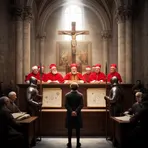
- The Congregation of the Inquisition played a central role in the trial of Galileo in the 17th century.
Examples
-
Many scholars faced the scrutiny of the Congregation of the Inquisition during the Counter-Reformation.
-
Historical records detail the procedures followed by the Congregation of the Inquisition in pursuing cases of heresy.
-
The Congregation of the Inquisition was established to combat heresy.
-
Did the Congregation of the Inquisition try Galileo?
-
Historical records detail the procedures followed by the Congregation of the Inquisition in pursuing cases of heresy.
-
Many scholars faced the scrutiny of the Congregation of the Inquisition during the Counter-Reformation.
-
The Congregation of the Inquisition played a central role in the trial of Galileo in the 17th century.
Synonyms


 1
8.7
1
8.7
A court set up by the Catholic Church in Italy in 1542 to punish people for new religious ideas
Surface Forms
Morphology
congregation + of + the + Inquisition
The phrase is a straightforward combination of 'congregation' (a gathered group/body) and 'Inquisition' (a tribunal for identifying and punishing heresy), so its meaning as the body or group associated with the Inquisition is directly derivable from the constituents. This is a literal, compositional proper name rather than an idiom or metaphor, and comparable noun-of-noun constructions occur cross-linguistically, so a B1 learner who knows the words would understand it.
Etymology
Congregation of the Inquisition comes from church words: a congregation is a group that meets in church, and an Inquisition is strict questioning to find 'heresy', which means wrong religious ideas. So the name shows a church group set up to look into and punish 'heresy', and that is why it refers to the church court that tried people like Galileo.