
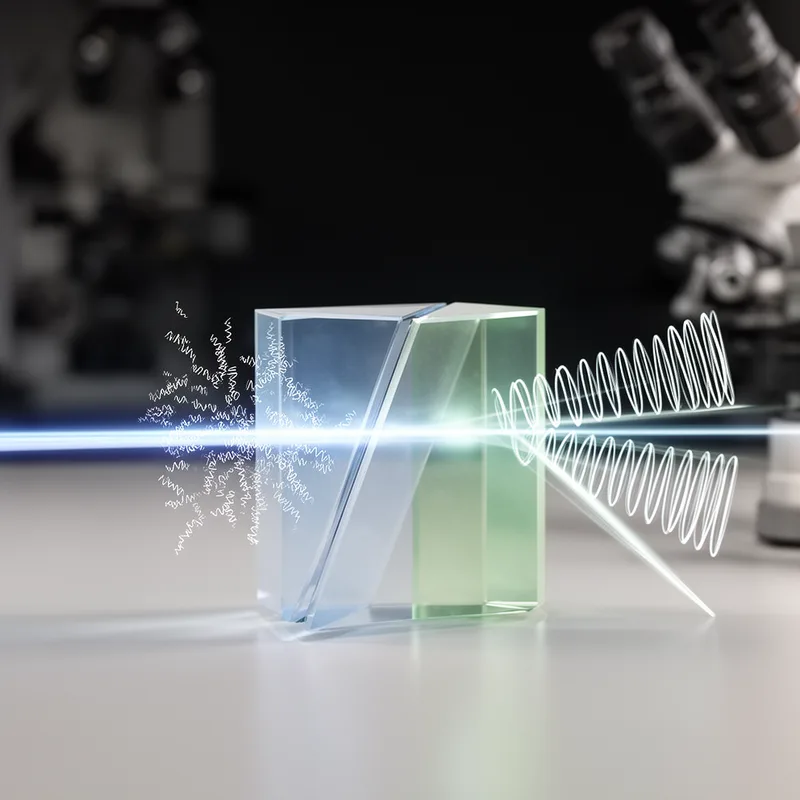
Rochon prism
- noun
- /roʊˈʃɒn ˈprɪzəm/
- Specialized
- Unlike other polarizers, the Rochon prism transmits the ordinary ray undeviated while deviating the extraordinary ray.
Examples
-
The technician adjusted the Rochon prism to achieve the desired level of polarization.
-
A Rochon prism is commonly used in scientific laboratories to polarize ultraviolet light.
-
The Rochon prism is essential in many optical experiments.
-
Have you ever used a Rochon prism in your lab?
-
A Rochon prism is widely used in laboratories to produce plane-polarized ultraviolet light.
-
In optical research, the Rochon prism helps scientists to effectively polarize visible light.
-
To demonstrate birefringence, the physicist introduced a Rochon prism into the light path.
Synonyms
Two clear crystal prisms joined together to make light that vibrates in one direction

A device made from calcite that makes light waves vibrate in one direction, used in microscopes
Surface Forms
Morphology
Rochon + prism
A B1 learner who knows 'prism' will recognize this as a type of optical prism (an object that refracts or splits light), so part of the meaning is directly recoverable. However, 'Rochon' is an eponym/proper name that conveys no semantic information about birefringence or polarization, so the specific technical properties cannot be derived from the constituents.
Etymology
Rochon prism is named after the scientist Rochon and is made of two clear crystals glued together. One light ray goes straight while the other is bent, so the prism makes light vibrate in only one direction, which is to 'polarize' the light.

