

Nicol prism
- noun
- /ˈnɪkəl ˈprɪzəm/
- Specialized
- A Nicol prism is often used in polarizing microscopes to produce plane-polarized light.
Examples
-
The Nicol prism relies on the birefringent properties of calcite crystals for its function.
-
Scientists use a Nicol prism to examine the optical properties of minerals and crystals.
-
The Nicol prism is essential in many optical experiments.
-
Have you ever used a Nicol prism in your experiments?
-
A Nicol prism is often used in polarizing microscopes to produce plane-polarized light.
-
Scientists use a Nicol prism to examine the optical properties of minerals and crystals.
-
The Nicol prism relies on the birefringent properties of calcite crystals for its function.
Synonyms
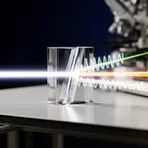
Two clear crystal prisms joined together to make light that vibrates in one direction

A device that uses two crystals to make light vibrate in one direction
Surface Forms
Morphology
Nicol + prism
The constituent 'prism' clearly signals the category (a type of prism), so a B1 learner would infer it is some kind of optical device. However 'Nicol' is an eponym/proper name that provides no lexical clue about calcite construction or the polarization function, so the specific meaning (producing plane-polarized light) is not derivable from the parts. This makes the expression partially transparent: category clear but technical function opaque without prior exposure.
Etymology
Nicol prism comes from William Nicol, who first made the device by cutting and joining a clear calcite crystal so it sent only one beam of light. One popular story says his clever cut 'split' the light, and that's why today a Nicol prism is the small device scientists use to make 'plane-polarized light', meaning light that moves in one direction.

