
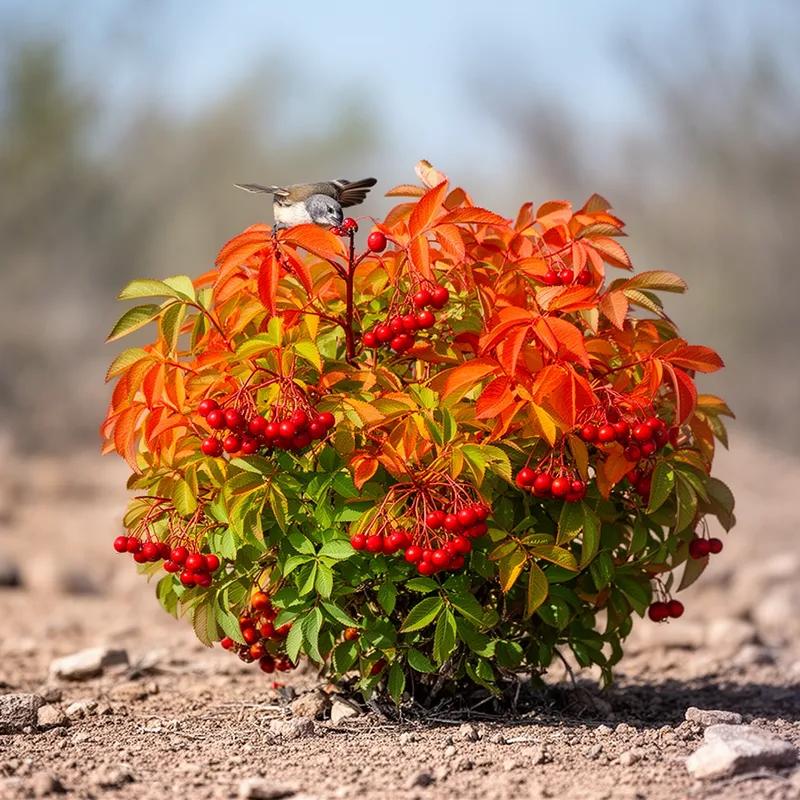
Rhus trilobata
- noun
- Specialized
- The berries of Rhus trilobata were traditionally used by Native Americans to make beverages.
Examples
-
Gardeners often plant Rhus trilobata for its drought resistance and vibrant autumn foliage.
-
Many animals feed on the fruits of Rhus trilobata during the late summer months.
-
The Rhus trilobata is commonly found in California.
-
Have you ever seen a Rhus trilobata in the wild?
-
Many animals feed on the fruits of Rhus trilobata during the late summer months.
-
The berries of Rhus trilobata were traditionally used by Native Americans to make beverages.
-
Gardeners often plant Rhus trilobata for its drought resistance and vibrant autumn foliage.
Synonyms



 1
9.9
1
9.9
A small California shrub with smelly leaves and red edible berries
A shrub that grows in dry California areas with three-part smelly leaves and edible fruit

A small bush with strong-smelling three-part leaves and edible berries
Surface Forms
Morphology
Rhus + trilobata
This is a Latin binomial: 'Rhus' (sumac) may be recognizable, but 'trilobata' is a specialized Latin epithet rather than an ordinary English word — its morphological parts ('tri-' and 'lobate') are not reliably interpretable by an average B1 learner. Species names are technical and not compositionally transparent to learners, so the MWE's botanical meaning cannot be derived from the constituent words alone.
Etymology
Rhus trilobata gets its name from older words: Rhus is the name for 'sumac' and trilobata means 'three-lobed', because each leaf usually has three parts. So the name gives a simple picture of a small sumac shrub with three-part leaves and berries people used to make drinks.