
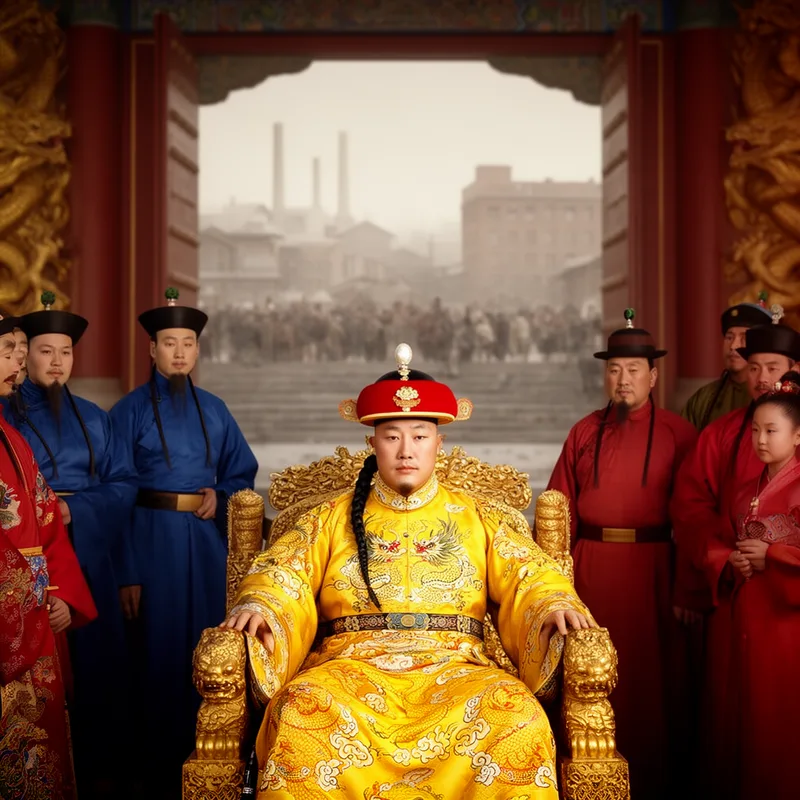
Qing dynasty


 1
7.2
1
7.2
- proper noun
- /tʃɪŋ ˈdaɪnəsti/
 :
dinastía Qing
:
dinastía Qing
- Even within the nationalistic political faction that supported an ideology of independence, there were members who were sympathetic to the Qing dynasty.
- Qing dynasty from 1644
- Qing dynasty in 1911
- Qing dynasty in China
Examples
-
Then China went into political chaos in the period following the revolution that overthrew the Qing dynasty in 1911.
Blog text (29) -
The Republic of China, as a modern nation-state, was first founded in 1912 after the overthrow of the imperial Qing dynasty (1644-1911).
Academic text (2018) -
Today we spoke of the late Qing dynasty.
Blog text (14) -
But this was not the only reason why the Qing dynasty of China was disturbed by these raiders in pirate boots.
Blog text (1) -
The Qing dynasty in China was overthrown before World War I, and in 1917 the Romanov dynasty fell from power.
Academic text (2006) -
Under the Qing dynasty, plains Aborigines had some political protection, since they again provided militia to the ruling regime.
Academic text (2001) -
Tibet is the only example of a part of China that broke away after the fall of the Qing dynasty and was reintegrated under the PRC.
Academic text (2001) -
Mongolia, like Tibet, was part of the Manchu Qing dynasty until its collapse in 1911.
Academic text (2001) -
Imperial Japan seized Taiwan from the Qing dynasty in China after the Sino-Japanese War (1894-95) and ruled Taiwan until its defeat in World War II in 1945.
Academic text (2004) -
The Qing dynasty ruled China from 1644 to 1912, marking the last imperial reign in the country.
Synonyms
 8
8.6
8
8.6
The last ruling dynasty of China that ruled from 1644 to 1912
 1
8.3
1
8.3
A family of rulers in China from 1644 to 1912
The last rulers of China from 1644 to 1912 who came from the Manchu people

The last imperial dynasty that ruled China from 1644 to 1912, founded by the Manchu people

The last royal family that ruled China from 1644 to 1912
Surface Forms
Morphology
The phrase is fully compositional: 'Qing' names a specific ruling house and 'dynasty' means a succession of rulers, so a learner who knows both constituents can infer it refers to the dynasty called Qing. This [name + dynasty] pattern is cross-linguistically common (e.g. Spanish/French/Chinese equivalents), and there is no idiomatic or metaphorical shift, making it transparent to learners who know the parts.
Etymology
The Qing dynasty takes its name from the Chinese word Qing, which means 'clear' or 'pure' and was chosen by the new rulers as a strong, respectful name. That's why Qing dynasty refers to the last imperial rulers of China, who ruled from 1644 to 1912.